Friday, January 29, 2016
Look Beyond Europe To India
What does India share in common with the United States, and why does it matter?
Vishal Mangalwadi, a scholar and follower of Christ from India, contends that Hinduism and Secularism share much in common. In his book Truth and Transformation, Mangalwadi asserts that moral relativism leads to corruption and poverty, and this approach to morality is the product of both Hinduism and Secularism.
In Hinduism, as in Secularism, there is no "Higher Law" that applies equally to all people, because there is no Higher Lawgiver. In Hinduism, there can be no source of moral order other than that which various groups create for themselves. This leads to different moral standards for different people.
"Growing mangoes or guavas alone, could lift whole families out of poverty [in India]," writes Mangalwadi. "But if hardworking peasants grew good mangoes and guavas, the higher castes would come and take them..."
In Hinduism, there is no God who has said, "You shall not covet your neighbor's mangoes."
Both worldviews reject the idea of a rational, transcendent God who has said, "You shall not steal," or, "You shall not covet," and to whom all people in every walk of life are equally accountable. The "upper casts" in India have practiced moral relativism for years, Mangalwadi contends. The result is rampant corruption, with upper casts stealing from lower casts with no consequence or shame. Because of this corruption, poverty abounds in India.
The net effects of Secularism ["there is no God"] and Hinduism ["everything is God"] are the same, because morality in both Hinduism and Secularism can be nothing more than human conventions. "Morality" depends on who makes the rules and has the power to implement them.
In the United States today, morality boils down to a 51% vote [the tyranny of the majority]. For me, as a follower of Christ, this is a chilling prospect. Because as a Bible-believing Christian, I am part of a rapidly increasing minority.
"The West," writes Mangalwadi, "is becoming corrupt like us [in India] because it is developing a 'new spirituality' without [true] morality. This new spirituality is no different than our [Hindu] old spirituality."
If Mangalwadi is correct, then to understand where the United States is headed, we must look beyond Europe to India.
Friday, January 22, 2016
Throw The Bums Out
| United we stand. Divided we fall. |
U.S. citizens are in a "throw the bums out" mood. There seems to be a lot of anger about the "broken system." The economy is not the only thing broken. Congress is broken. Families are broken. Our country is divided.
What's "the fix?"
Vishal Mangalwadi, in Truth and Transformation, wrote: "Roots of corruption go deeper than individual leaders and regimes. Dethroning leaders or smashing 'the system' rarely does lasting good...Ultimately it is our inner life─our assumptions, values, worldview, desires, emotion, and attitudes─as well as our relationships, that need to be transformed."
Such inner transforamtion, Mangalwadi contends, only happens when people embrace the Truth revealed in a book that the West no longer takes seriously: the B-I-B-L-E.
Allan Bloom was a professor at Cornell University, the University of Toronto, Yale University,
and the University of Chicago. He was not a Christian. Yet, in his book, The Closing of the American Mind, written in 1987, Bloom put his finger on our problem:
"In the United States, practically speaking, the
Bible was the only common culture, one that united the simple and the
sophisticated, rich and poor, young and old, and—as the very model for a vision
of the order of the whole of things, as well as the key to the rest of Western
art, the greatest works of which were in one way or another responsive to the
Bible—provided access to the seriousness of books. With its gradual and
inevitable disappearance, the very idea of such a total book is disappearing.
And fathers and mothers have lost the idea that the highest aspiration they
might have for their children is for them to be wise—as priests, prophets or
philosophers are wise. Specialized competence and success are all that they can
imagine. Contrary to what is commonly thought, without the book even the idea
of the whole is lost.”
Our division is the natural consequence of the loss of "the book." While we may question Bloom’s assertion it was “inevitable” that the biblical vision of the order of the whole of things would disappear, it has. Today, a vision "for the whole of things" is confined to
the four walls of certain churches, and the private lives of certain individuals.
Our system is broken. Could this be the consequence of the loss of
a vision for “the order of the whole of things” that Bloom said "the book" once provided?
Friday, January 15, 2016
What Is At Stake With Our Young People
![]() |
| This is beautiful, historic downtown Staunton, Virginia, in Augusta County, USA. One of the schools we are working with, Grace Christian School, is located here. A week before Christmas, the public schools of Augusta County were closed for a day because of possible "risk of harm to school officials" amid an angry backlash of parents over an assignment given to some high school students at Riverheads High School. The assignment was for the students to copy the Shahada in Arabic calligraphy. The Shahada is a Muslim creed, which says: "There is no God but Allah, and Muhammad is the messenger of Allah." The parental revolt made national news. John Morrison, the Superintendent of Grace Christian School, commented on this matter in his blog to parents this week. With John's permission, I am passing his words on to our readers. [Photo by henristosch, CC BY-SA 2.0 de, Wikipedia.] |
While Christian parents at that particular school may have been justifiably concerned about the teacher's assignment, I believe they have missed the deeper, more fundamental issue. And that issue is simply this: what is the basic religious worldview that their children are being taught everyday in public school, and is the content of that worldview perhaps far more alarming than the assignment this public school teacher gave to her students?
The following quotation from our dear friend, Dr. Christian Overman, founder of Worldview Matters, articulates my concerns quite succinctly:
"If it is a religious matter to teach ─ or imply ─ that the Bible provides a standard for moral order, is it not also a religious matter to teach ─ or imply ─ that it does not? If it is a religious position to say, 'Jesus is Lord of all, and by Him and through Him all things exist,' is it not also a religious position to say ─ in so many words, or lack thereof ─ 'Christ and the Bible are irrelevant to our discussion on biology, art and math?' Are not both statements religious statements?
To teach students that Christ and the Bible are irrelevant to biology, art and math can be done very effectively without telling them this directly. A teacher does not have to stand in front of a class and say 'the Bible has nothing to do with our discussion' to communicate the message that the Book is irrelevant.
If we think the current U.S. system of education is religiously neutral, we must think again. If state schools were indoctrinating children in Buddhism, Islam or Native American Animism, many Christian parents would hit the ceiling. Maybe. But when it comes to the indoctrination of children in John Dewey's so-called 'Common Faith,' which he referred to as a non-theistic faith, Christian parents are curiously passive."
Because of what is at stake with our young people, I am not overtly concerned about stepping on toes with the above comments. We should not be surprised at the devastation of our national values and those of our young people that are largely the outcome of secularist education!
We cannot throw out long-standing traditions of Christian education as practiced by the Church down through the centuries, by turning our children over so secularist educators, and then expect them to stand in our faith.
Previous generations clearly understood this. What will it take to awaken ours?
Friday, January 8, 2016
A Workplace Ministry Pastor
| Engraving of Jonathan Edwards by R. Babson and J. Andrews. (Public domain) |
Jonathan Edwards (1703-1758) was a pastor, a missionary to Native Americans, and the third President of Princeton University. Among his descendants came scores of pastors and missionaries, 120 college professors, 110 attorneys, 60 authors, 30 judges, 13 college or university presidents, 3 congressmen, and one Vice President of the United States.
But there's more to the story.
While doing eight years of Ph. D. research on Jonathan Edwards, Dr. David Scott discovered something remarkable:
"One day…I came across the discipleship curriculum that the puritan pastor Jonathan Edwards had been trained in by his church in how to have a God-filled work life. They even had a name for it…'technologia,' a Latin term for their little-known method of teaching the art of God-centered work.... Edwards and his fellow students—future pastors and merchants alike—were tested in it in order to graduate from early Yale. The Puritans knew what it meant for the church to purposely pastor people in their work. We do not.” [For more, see "A Church Without A View: Jonathan Edwards And Our Current Lifeview Discipeship Crisis."]
The English Puritan Pastor George Swinnock said: "The pious tradesman will know that his shop as well as his chapel is holy ground." No doubt this was because the Puritan view of work was systematically built into the minds of "pastors and merchants alike" through the church. This was normative.
Yet today, for the most part, a "systematic worklife discipleship" effort by the church has gone the way of men's powdered wigs.
But things are slowly changing. Though small in quantity, an increasing number of pastors are making "systematic worklife discipleship" a priority. Tom Nelson, author of Work Matters: Connecting Sunday Worship To Monday Work, the Pastor of Christ Community Church in Leawood, Kansas, is a good example. Tim Keller, author of Every Good Endeavor, and Pastor of Redeemer Presbyterian Church in New York City, continues to be a leading voice in this matter.
A local church in our area, Cedar Park Church, has placed a man on staff to serve as a Workplace Ministry Pastor. Paul Graves' total focus as Workplace Ministry Pastor is to help members of Cedar Park Church to discover their calling at work. Paul, a good friend of mine, has created GodWork 360 to restore a "systematic approach" to worklife discipleship through the local church.
For more, see: http://www.cedarpark.org/ministries/workplaceministry/.
| Paul Graves, Workplace Ministry Pastor at Cedar Park Church, Bothell, Washington, USA, heads up GodWork 360. The hair is different than Edwards', but the heart is the same. |
Friday, January 1, 2016
The Truth And Baloney Detector
| ||||||
One of our WRAP schools [Worklife Restoration and Advancement Project] is Grace Christian School, in Staunton, Virginia. The High School Principal, Brian Fitzgerald, sent the following message to parents before the opening of the new Star Wars film. In it, Brian recommends a teaching tool presented in the WRAP training, called, the Truth and Baloney Detector:
Dear GCS Parents,
How should a Christian approach a film like Star Wars?
Thoughtfully. We should be active
viewers, being conscious of the ideas coming through the art. We need to teach
our kids and students to do the same, learning to detect truth from baloney.
And there’s an app for that! Well...a tool.
It's called the Truth
and Baloney Detector, and we will be using this tool more often in GCS
classrooms. This tool is designed to help us engage thoughtfully with media.
It’s easy to pick apart a film and identify everything that’s wrong with its
ideas. It takes more humility and discernment to identify truth in these same
films. Yet be vigilant in separating it from baloney.
The Truth and Baloney
Detector is an excellent tool to use to talk with your children about the
movies they watch, especially if you are watching with them. Our kids are
going to watch movies, so let’s teach them how to watch well, with the biblical
worldview as their framework.
I recommend filling out the attached Truth and Baloney Detector together as a family. It may seem like a
lot of work for watching a movie, but thinking biblically is necessary work. If
we don’t actively engage with our entertainment, what’s the alternative?
Damon of Athens, a contemporary of Plato, said, “Let me write the songs of a nation, and I
care not who writes its laws.” Law enforces a code. Entertainment teaches
culture. You can write and implement laws to make people outwardly conform to
certain standards, or you could smuggle those same ideas into people’s minds by
packaging them in movies that everyone willingly watches.
Let’s love God with
our minds, take captive thoughts that are counter to Christ, and teach our children to do
the same.
For your Truth and Baloney Detector, click here [downloaded file].
Well done, Brian! The following link explains how to use the Truth and Baloney Detector in detail. I recommend watching this with your son/daughter before using the tool: https://youtu.be/WW1_8utGspo
May the Father be with you!
Friday, December 25, 2015
The Big Idea Behind Christmas
| Today's post appeared six years ago, during my first year of blogging, and has been a Christmas tradition since. |
One of my favorite Christmas carols is Joy To The World. The words are by Isaac Watts, based on Psalm 98: "Make a joyful noise unto the Lord, all the earth; make a loud noise, and rejoice, and sing praise. Let the floods clap their hands; let the hills be joyful together before the Lord; for He cometh to judge the earth, with righteousness shall he judge the world, and the people with equity."
Some say the song is not about the birth of Christ in Bethlehem, but about His second coming. The joy that is sung about, then, is a future joy that will occur when Christ returns, to “make the nations prove the glories of His righteousness,” in that full expression of His Kingdom yet-to-come.
This may be what Watts had in mind, but the song makes as much sense to me as a celebration of Christ's first coming. While I’m looking forward to that full and perfect expression of the Kingdom-yet-to-come, I’m also celebrating Christ's King-domain already here. Jesus is Lord of all. Today! Not just in the future, but at this present moment (Acts 10:36-37).
Christ's Kingdom hasn't fully arrived, nor is it perfectly realized yet. This will happen when Christ comes the second time. But the domain over which Christ is King (that is, His King-domain) includes both heaven and earth right now. He is holding it all together by the word of His power (Hebrews 1:3). Today.
This is the greatest Christmas gift: that Christ came “to make His blessings flow, far as the curse is found, far as the curse is found.” His blessings flow through people who are reconciled to God, and who, in turn, are reconciling all things to Him, including the things of earth, far as the curse is found. Today!
This is the big idea behind Christmas. (See Col. 1:16-20, and To Reconcile Not Only People But Things.)
So, no more let thorns infest the ground. By God's amazing grace, let's go back to work after Christmas, to pull up some bramble bushes and plant some redwood trees.
Joy to the Earth! the Savior reigns; Let men their songs employ; While fields and floods, rocks, hills, and plains, Repeat the sounding joy, Repeat the sounding joy, Repeat, repeat the sounding joy!
Far as the curse is found.
Friday, December 18, 2015
A Nigerian Investment That's Really Working!
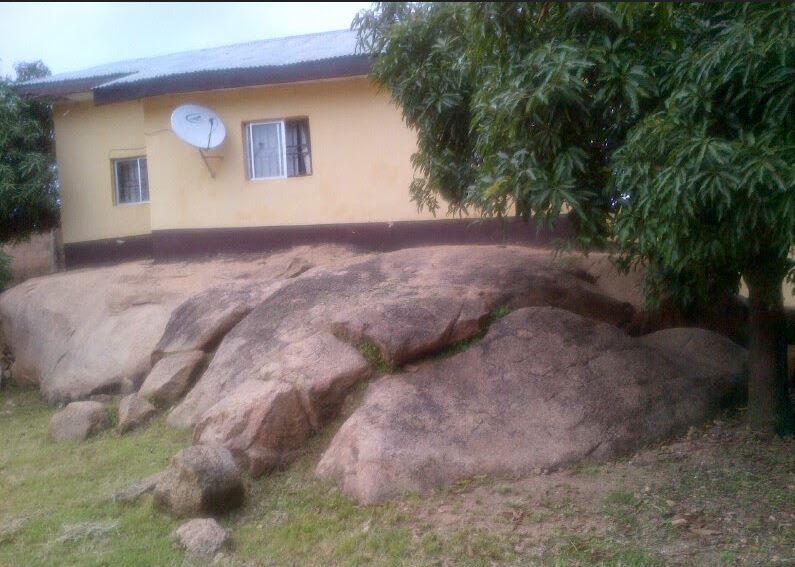
| A wise school leader builds his office upon a rock. This is the office of Segun Gbolagun, Director of The Kingdom Citizens International School, in Jos, Nigeria. |
Last week, we highlighted the Worklife Restoration and Advancement Project, or, as we call it, the WRAP. Currently, there are a handful of Christian schools in the USA and abroad that are involved in this project. Lord willing, there will be more to come.
These WRAP schools are actively restoring theology of work to the curriculum in a way that is systemic, intentional and repeatable. It is a rigorous, multi-year process for each school.
In addition to the WRAP schools, Worldview Matters is working with selected cohorts of Christian educators involved in early education through graduate school. These specialized cohorts are in the United States, South Korea, Uganda, Guatemala and (starting in January) Bogotá, Colombia.
Each WRAP school and leaders' cohort participates in a 9-month distance-learning course developed especially for Christian educators, called, Increase Meaning: A Wholistic Approach To Christian Education. It is through this venue that Worldview Matters is able to train educators around the world without leaving our office in northwest USA. [Actually, anyone in the world can enroll in this course. For more information, click here.]
Thanks to a grant from the MustardSeed Foudation and Bakke Graduate University, we have been working for the past 1-1/2 years with a WRAP school in Jos, Nigeria, called The Kingdom Citizens International School.
You may know Nigeria as home to a vicious Islamist group called Boko Haram. This gang of thugs has killed 20,000 people since 2009, and displaced 2.3 million people from their homes, primarily in northeast Nigeria. Last March, the group declared allegiance to ISIS. The name "Boko Haram" means: Western education is evil. (How would you like to be operating a Christian school in this neck of the woods?)
Recently, in a conversation with Segun Gbolagun, the Director of The Kingdom Citizens International School, I asked him if they were in any danger from Boko Haram. "Oh, no," he replied. "Boko Haram is far away from us." When I asked him how far, he said: "Oh, they are about a six or seven hour drive from us."
This information was not all that comforting to me.
Last week I recorded a video call with Segun and Dot Reju, Pastor of The Kingdom Citizens Pavilion, the church that oversees this school. I want to share some of our conversation with you. I think you'll agree, this is a Nigerian investment that's really working!
If the video does not play, click here: https://youtu.be/q9C3Jbe_DLc
Friday, December 11, 2015
Worklife Restoration and Advancement Project
![]() |
| Why should Christians value machines? |
On a fourth grade science test after a unit on pulleys and machines, Mrs. Curry included the following question:
Why should Christians value work and machines?
Here are some of the answers she received:
"Because they help us through life, and God gave us the material to make them."
"God wants us to use our brains to worship Him, and machines help people to worship God."
"Because God said to do work, and machines help us to do work."
"Because people can glorify God by building things that they have never built before."
"God gave us the thought of them and they make it easier to serve God."
"Because God made us to do work, not to just sit around and do nothing. So when we work, we should want to do it easily if we have to do it all the time."
"Because God made us to do work and live. We should make it easier by using simple machines."
"Because it is God's purpose for us."
"God created people so people can invent machines."
I received this report from Dean Ridder, Headmaster at Isaac Newton Christian Academy, Cedar Rapids, Iowa. Dean ended his message with: "Not bad for 10 years old."
An understatement.
Worldview Matters is working with Bakke Graduate University and the Institute for Faith, Work & Economics to restore a biblical concept of work via elementary and secondary education. We do this through the WRAP: Worklife Restoration and Advancement Project. We have been working with Dean's school for the past 2½ years. [For details about the WRAP, click here.]
In another note, Dean relayed:
"Our enrollment has grown by 10% since last year (and is still growing--we have families still actively participating in the enrollment process for this year). When I was asked to what do we contribute this growth when enrollment is dropping at Christian schools in our area, I had a good answer. 'People are hearing about our efforts to elevate the level of biblical worldview integration and incorporation of theology of work in our classrooms, and are responding to it.'"
Below is a clip of another INCA teacher, Mrs. Greer, having a conversation with 5th grade students on the topic of ecosystems and work. Here is an example of authentic Christian education, helping students to think about all things, including work, in the context of a biblical frame of reference:
Subscribe to:
Posts (Atom)