test
A Publication of RenewaNation: Helping Children Develop a Biblical Worldview.

To Link To The RenewaNation Website


Friday, September 29, 2017

The Underestimated Power of Silence


Christianity was divorced from state schools in the U.S. during the 1960s. "Religion must be separated from education!” was the message from The Bench.

But don’t smart judges know it’s impossible to separate religion from education?

If it is a religious position to teach—or imply—that the Truths of Scripture are relevant to math, science, history and language, is it not also a religious position to teach—or imply— that these Truths are not relevant? 

If it is a religious position to say, “Jesus is Lord of all, and by Him and through Him all things exist,” is it not also a religious position to say—in so many words, or lack thereof— “Christ is not relevant to our discussion of biology, business or Macbeth?” Are not both statements religious positions?

To teach students that the Bible is irrelevant to biology, literature and math can be done very effectively without telling them this directly. A teacher does not have to stand in front of a class and say, “the biblical worldview has nothing to do with our subject” to communicate the message that the Book is irrelevant.

All they need to do is never mention how any subject relates to the Book that is above all other books, and give students the impression that the secularist worldview and postmodern paradigms of our day are true by never saying otherwise.

This is the underestimated power of silence.

For schoolchildren, this silence is far more effective than speech. Multiply it by 13 years, and in just 3 generations you'll see a much different nation come forth than Noah Webster envisioned, and Alexis de Tocqueville observed. Welcome to 2017.

If we think state education is religiously neutral, we must think again. Today, millions of children are being indoctrinated into John Dewey's self-described "Common Faith" (a non-theistic religion), under the guise of “neutrality."

How's this working out?

When teachers don't place a single academic subject into the context of a biblical frame-of-reference, are those teachers really being "neutral?"

Is it any wonder that our youth are leaving the Faith? The Book is irrelevant to anything of real importance! If it were relevant, why are its overarching Truths never mentioned in relation to a single academic subject for 13 years, and these Truths are not on any test?

They used to be self-evident. But no longer.

The underestimated power of silence.

Posted by 


Friday, September 22, 2017

Seeing Snails In Context


Last week I wrote about the problem of secularized education. What exactly does secularized education look like?

It looks like a biology class that never discusses God's purpose for living things, or how plants and animals fit into God's plan for humans to govern over creation, or how living things fit into our calling to love people, and what responsibilities (under God) we have with respect to plants and animals, or what plants and animals reveal about the character of the Creator, etc., etc. 

It is the bigger picture of reality that brings meaning to a subject, beyond the subject matter itself. Secularized education separates academic subject matter from the bigger picture of reality.

What does DE-secularized education look like?

It looks like the example below, from Lighthouse Christian School, in Gig Harbor, Washington, under the excellent leadership of my friends Stephen Roddy and Cindy Mathisen. 
For the past 3 years, Lighthouse Christian School has been working with Worldview Matters in a rigorous teacher-training program called, the WRAP [Worklife Restoration and Advancement Project]. One of the instructional tools the teachers are trained to use is the "Conversation Starter."

This tool helps teachers organize their thoughts on how they might help students understand whatever they are studying in the context of a larger frame-of-reference: the frame-of-reference provided by the biblical view of God, Creation, Humanity, Moral Order and Purpose.

In the example below, students are seeing snails in context. You might say they are "contextualizing snails." 

This is not something you'll find in secularized schools. DE-secularized education unites academic subjects with the bigger picture of reality. It brings meaning to the subject, beyond the subject matter itself. I call it “wholistic” education.

This is real education for the real world. It is putting academic subject matter into the context of the bigger picture of everything, or, the biblical worldview. In the process, it strengthens relationships with the Creator, as well as with fellow human beings.

Below are students from Mrs. Kim Tarr's 2nd grade class, "contextualizing" snails:

Mrs. Tarr had the students work in 5 small groups. Each group had 1 question to discuss. This group focused on the question: "What purpose does God see in a snail?"


This group focused on the question: "What is BEST about snails?" (No doubt these boys loved that question!)

Mrs. Tarr posted the students' finished work on the wall, and the class had a large-group discussion. 

How would you answer this question?

This is the actual graphic organizer, called the "Conversation Starter," that Mrs. Tarr used to organize her thoughts ahead of the students' conversation about snails. Click the image to enlarge it, and read Kim's comments about each of these questions. You will see thought-provoking questions related to the 5 worldview components of God, Creation, Humanity, Moral Order and Purpose. 

If you are a school principal wanting to discuss the WRAP program via telephone or an Internet video connection with me (Christian Overman), send me a note to set up a time, here.

We work with educators in any part of the world through our distance learning program. We have trained educators in Africa, Latin America, Asia, as well as the U.S.A., through the Internet successfully. 


*  *  *  

Help re-direct the course of history for as little as $1 per post:

https://www.patreon.com/worldviewmatters

Friday, September 15, 2017

Secularized...Privitized...Demonized

Hurricanes are not the only storms hitting the USA. 
(Photo used by permission of NOAA.)

Is it any wonder the biblical foundations for law, government, family and gender that once provided commonly accepted harbor lights for U.S. society have been replaced? The incessant move toward the secularization of education and the privatization of Christianity over the past century has been enormously successful, expedited greatly through elementary and secondary schools.

By divorcing biblical Truths about God, Creation, Humanity, Moral Order and Purpose from the study of language, math, literature, science, history, civil government and the arts, elementary and secondary schools created a sacred-secular divide in the minds of youth that has spanned several generations. Christianity was first secularized in our schools, and this made it easy for Christianity to be privatized in society. And now it is being excluded from the public square, constricted by both public opinion and judicial pronouncements.

Strong winds are trying to confine biblical Christianity to one’s personal life and Sunday services. Our constitutional free exercise of religion is being re-defined as "freedom of worship" (in a building called “church.”) Furthermore, that which was first secularized and then privatized, is now being demonized. Bibliocentric Christians are branded “intolerant,” “bigots” and “haters.”

Secularized...privatized...demonized. 

What doesn’t make sense is why so many pastors have remained silent about secularizing education. Sending a child to a school that divorces Truth from academics, and never mentions God's purpose for learning, is nuts. Education that does not help students to see all knowledge in the context of the True Frame-of-Reference is like a church that teaches all about the Bible but makes no connections with how to live.  

Bible-believing Christians would not tolerate such a church. Yet 85 to 90 percent of evangelical parents send their children to schools where they are indoctrinated into secularized-privatism. Sending kids there to be “lights in the world” sounds good, until they come home thinking like their textbooks, making no connections whatsoever between any subject matter and the bigger picture of God, Creation, Humanity, Moral Order and Purpose. They make no connections between God and history, and they think Christianity is just for church. Not for directing a business, designing software or doing civil service.

The same pastors who would never tolerate a so-called “neutral-and-values-free” Sunday School have been silent about a so-called “neutral-and-values-free” Monday through Friday system that is anything but.

Now the chickens are coming home to roost. There's another storm in progress, more destructive than Harvey and Irma combined. 

*  *  *  

Help re-direct the course of history for as little as $1 per post:

https://www.patreon.com/worldviewmatters

Friday, September 8, 2017

A Lesson That Could Change History

The Herman Miller Celle Chair won the GOOD DESIGN award from the Chicago Athenaeum Museum of Design and Architecture

One month ago today, on August 8, 2017, a great model of a man who knew how to live out his faith in the workplace, Max De Pree, went to be with the Lord, at the age of 93.

De Pree was the son of D. J. De Pree, founder of the Herman Miller company. Max served as its CEO from 1980-87. The company is one of the largest manufacturers of office furniture in the world.

De Pree wrote best-selling books on good business practices, and was not shy about letting his readers know where his business values came from. They were unashamedly rooted in the biblical worldview.

Last week, we looked at how a person's beliefs about God, Creation, Humanity, Moral Order and Purpose (their "worldview") shape values, which in turn shape behavior. Few business leaders have explained how this principle works in the business world better than Max De Pree.

Take some lessons from Max De Pree himself via the short (3.5 minute) video below, and discover how De Pree developed his biblical worldview. It happened in a certain place, and in a certain way. This lesson may be De Pree's most important lesson of all. A lesson that could change history:


If the video does not play, click here.

Help re-direct the course of history for as little as $1 per post:

https://www.patreon.com/worldviewmatters


Friday, September 1, 2017

A Divine Cure for Saddle Sores


Where do values come from?


After blogging for 7 years and then taking a 1-year rest from it, I'm back in the saddle again. Feels good!

I experienced a divine cure for saddle sores. It's something God prescribed a long time ago: stay off the horse for a while. 

Rest is a vital part of the work cycle, and it can actually result in getting more accomplished in the long run!

That's what happened to me. During my break from blogging, I turned my attention toward the development of other materials for parents, creating a small-group curriculum that can be used in churches, Christian schools and neighborhoods, called Working Wonders.

Today, I'm sharing a sample video clip from this course that addresses the question, Where do human values come from? 

This short clip addresses this important matter:


If the video does not play, click here.

Help re-direct the course of history for as little as $1 per post:

https://www.patreon.com/worldviewmatters

Friday, May 26, 2017

God's Pleasure At Work


During my sabbatical from blogging, I have not taken a vacation from writing!

John Beckett, Chairman of The Beckett Companies and author of Loving Monday, calls God's Pleasure At Work, "the finest and practically helpful publication ever produced on this subject."

During the past school year, this e-text was field-tested at a Christian school in Kansas, with high school students. Below are comments from students in that class:

"I really love how this book shows us that we should not look at life a sacred and secular, but rather everything that we do can either be for the glory of God or contrary to His will."

"…I have benefitted so much from this class…Dr. Overman delivers his points clearly, with accuracy to Scripture. I would highly recommend the Theology of Work material and class to everyone at [name of school]." 

"...I learned so much personally that I cannot wait to use in the future and share with others. I believe all Christians should read this book and soak in all the goodness just like our class did over the course of this year." 

The book is not just for high school students! It is for adults of any age and stage of life. 

Perhaps the best way to introduce the new e-book edition of God's Pleasure At Work & The Difference One Life Can Make is through a review posted in The Green Room, here.

To purchase your copy, click here.

Wednesday, August 24, 2016

The Lost Purpose for Learning


For your free copy of this e-book, click here.

We don't find meaning in learning, we bring meaning to learning. If we can, that is. 

“Whatever!” seems to be a common bored attitude of children toward school. Bribes, threats, and lures of a future well-paying job fail to inspire them. This is to be expected, if we fail to give them a compelling reason for their very existence. 

All sons and daughters are endowed before birth with a remarkable mandate from God. It's a mandate that brings extraordinary meaning to education. The Lost Purpose for Learning explains what that mandate is, and why it brought about such an extraordinary level of flourishing for people in the United States. 

Yet, it has been neglected for the past 150 years. This new book, The Lost Purpose for Learning, explains what the lost purpose is, and how it can be restored to education at all levels.

If you prefer a hard copy, click here.

Friday, May 13, 2016

The Smelliest City Of Europe

Geneva as it looked in 1602. [Artist unknown.]

In the early 1500's, Geneva was called “the smelliest city of Europe.” The walls of the city were in disrepair, the people were poor, and families were falling apart. The condition of the church was deplorable. Proof? Priests operated houses of prostitution.

The people ran the bishop of Geneva out of town in 1530. William Farel, a French evangelist, came in 1531. Preaching in the marketplace, Farel cried out, "We must reform the church in order to reform the nation!"
 
In 1535 the electors of the city voted unanimously, and courageously, to proclaim Geneva a Reformed Protestant city. I say courageously because, as Thomas Bloomer notes in Calvin and Geneva: Nation-Building Missions, "they were risking excommunication and eternal damnation."

Farel sought out John Calvin, imploring him to come to Geneva to apply the theology he had written about in Institutes of Religion: "May God curse you and your studies if you do not join me here in the work He has called you to!"

Calvin came to Geneva at the age of 27, and rebuilt the city on three principles:

1. Preaching the Gospel: "...so that people would be saved and start to be transformed and the church would be restored to biblical purity."

2. Teaching: "...so that people would know how to live, the authorities would know how to govern, and all would know how to work in their different spheres."

3. Accountability: "...so that the teaching would not just be theoretical but applied in all areas of life."

Calvin taught that a "holy vocation" included the work of the banker and the shoemaker. Bloomer writes: "Calvin told the bankers they couldn't charge high interest rates, as that was the sin of usury in the Bible….The 4 percent interest rate lasted for four centuries in Switzerland, and this practice was one of the long-term sources of Switzerland's prosperity."

Geneva became a model city for theology of work in practice. It became known as, “the city on a hill.” John Knox came to study what Calvin was doing, and took what he learned back to Scotland. England was also influenced by Geneva, and eventually brought this influence to North America.

We should all know the full story. It can be found in Thomas Bloomer’s essay, Calvin and Geneva: Nation-Building Missions, published in His Kingdom Come (YWAM Publishing). Bloomer's essay contains many lessons we could all use a refresher course on about now. Click here.

Friday, April 29, 2016

Why Should Christians Value Machines?


Why should Christians value machines?

In a 4th grade test on pulleys and machines, Mrs. Curry included the following question: 

Why should Christians value work and machines?

Here are some answers she received: 

"Because they help us through life, and God gave us the material to make them."

"God wants us to use our brains to worship Him, and machines help people to worship God."

"Because God said to do work, and machines help us to do work."

"Because people can glorify God by building things that they have never built before."

"Because God made us to do work, not to just sit around and do nothing.  So when we work, we should want to do it easily if we have to do it all the time."

"Because God made us to do work and live. We should make it easier by using simple machines."

"Because it is God's purpose for us."

"God created people so people can invent machines."

I received this report from Dean Ridder, Headmaster at Isaac Newton Christian Academy, Cedar Rapids, Iowa.

Worldview Matters is working with Bakke Graduate University and the Institute for Faith, Work & Economics to restore a biblical concept of work, economics and human flourishing to elementary and secondary education. We do this through a specialized training program called the WRAP: Worklife Restoration and Advancement Project. Dean's school is part of this program.

Applications for the WRAP are now being accepted for the 2016-17 school year. The number of schools we can accept is limited. Early applicants have a better chance of receiving grant funding.

For details click here. To set up a time for a personal conversation to discuss the program, use the Worldview Matters contact page, indicating the best day, time and phone number to reach you, here.

Dean also relayed: 

"Our enrollment has grown by 10% since last year (and is still growing--we have families still actively participating in the enrollment process for this year). When I was asked to what do we contribute this growth when enrollment is dropping at Christian schools in our area, I had a good answer. 'People are hearing about our efforts to elevate the level of biblical worldview integration and incorporation of theology of work in our classrooms, and are responding to it.'"

Below is a clip of Mrs. Greer, 5th grade teacher at Dean's school, having a conversation with students on the topic of ecosystems and work:


If the video does not play, click here.

Friday, April 22, 2016

What Better Time Than This?


 Click this image to enlarge it.
 
Chuck Colson founded the "Centurions Program" in 2004 for the purpose of equipping 100 followers of Christ per year to “live out their faith authentically in the world.” I was privileged to participate in the 5th group of Centurions, in 2009, and I'm glad I did.

For many years, it was only possible to participate in the Centurions National Program, but now there are five additional Affiliate Programs as well. These Affiliate Programs are located in Washington State, Colorado, Michigan, Wisconsin and New England. Applications are now being accepted for the 2016-17 year, and I urge you to seriously consider this opportunity.  

I know the leaders who are heading up the Washington State Affiliate, and I commend them to you. This Affiliate will be meeting monthly on the campus of Northwest University, in Kirkland. The fee for the Washington Affiliate Program is $750 for the year. If you have questions about the Washington State Affiliate, contact my friend Steve Hunter at WAHunters@comcast.net, or call him at 714-501-6527.

Dr. Joseph Castleberry, president of Northwest University, has stated: “The Centurions Program, in our view, is consistent with our mission of ‘carrying the call of God by building a learning community dedicated to spiritual vitality, academic excellence, and empowered engagement with human need.’  To this end, we see the University as not just the physical campus but the community at large. Our hoped-for affiliation with Seattle Centurions is one important way for the University to ‘carry the call of God’ to the community, while in turn drawing the community to the opportunities for enrichment offered by the University.”

Participants in the Centurions Program are exposed to a curriculum of important books and films, with access to online discussion forums with nationally-known speakers, such as Joni Eareckson Tada and John Stonestreet.

For more details, visit the Colson Fellows Program website, at www.ColsonFellows.org.

If you want to make a difference, click here for an application to the Centurions Program. 

What better time than this?
 

Friday, April 15, 2016

We Have Become Fools


Take your pick.

In the United States, serious discussion is now going on about whether or not we should allow males who think they are females to use women's bathrooms and shower rooms, and vice versa. This includes allowing students in elementary and secondary schools to make the same choice, depending on which "identity" they choose. If you live in the contemporary West, this conversation is coming to your town soon.

How did we get to this point?

The answer is found in Romans 1:18-32. The contemporary West has gone the way of the ancient Romans, who went the way of the ancient Greeks before them. We (I use the term in a general sense) have "suppressed the truth in unrighteousness" for the past 150 years, and God has now given us over to a way of thinking that can only be described as "futile," "foolish," and "darkened." These are the apostle Paul's terms.

Professing ourselves to be "wise," as the most esteemed thinkers of our age have thought themselves to be (I am referring to the likes of Friedrich Nietzsche, Charles Darwin, William James, John Dewey and Jacque Derrida), we have become fools. 

A new video clip of students being interviewed on the campus of my alma mater, the University of Washington (produced by the Family Policy Institute of Washington), proves the point beyond any shadow of doubt. Among other critical issues, the video addresses the question of whether a 5'9" white man who says he is a 6'5" Chinese woman is wrong─or not. You must see it to believe it.

I think I'll be sending my sheepskin back. 

Click here.


Friday, April 8, 2016

The Unpardonable Postmodern Sin


The Church around the world just celebrated Easter. And in case you did not notice, music was a big part of that celebration.

You can tell a lot about a worldview by the kind of music it produces.

If you visit a Muslim mosque, you will not see an organ or a piano. Nor an acoustic guitar. No choir will sing, nor the congregation. Why? Because devout followers of Mohammad believe music is heram, which means "illegitimate." Some mosques make an exception for vocal sounds that come out sounding like non-melodic chants. Westernized Muslims are not as strict when it comes to music, but in traditional Islam (by this I mean "fundamentalist" Islam), music-making is intentionally absent.   

Buddhists view life as a cycle of suffering caused by human desire. Salvation, for the Buddhist, is escape from suffering through extinction of desire. Joy To The World is not something you would hear in a Buddhist temple. Life is not something you celebrate. There is no personal God to sing about. The closest thing to music coming out of a Buddhist's vocal chords would be a single-note drone. Some Buddhists incorporate Western-style music into their practice, but this is a relatively recent phenomenon, introduced by Westerners converted to Buddhism.

Do you know of any music stores with a section called, "Pure Hindu Hits?"

Westerners take melody and harmony for granted. But "Western" music did not spring from a vacuum. It came from a Christian motivation that viewed music as a way of worshiping the Almighty God who dresses flowers with more colors than a King's robe. It came out of a worldview of hope and joy, which produced harmony and melody as a means of praise, thanksgiving and celebration.

Yes, "Western" music came out of Christian worship. Worship that birthed single-voice melody called “Plainsong” [which later developed into Gregorian Chant] starting in the 3rd century, then in the 9th century developing into two-voice melody, and eventually polyphony [multi-voice music]. Out of this came Handel, Bach, Beethoven, and that remarkable phenomenon we now call “Western" music.  

The next time you download that favorite song from i-Tunes, you can thank a Christian monk. Better yet, thank the living God who inspired the monks who worked to develop polyphony. Then think about what this world would be like if Christ had never been born.

In this post I have committed the unpardonable postmodern sin. I have compared the Christian worldview with others, and found the others to be wanting. In postmodern times, all worldviews are supposed to be equally good. Frankly, I don't buy it. The music tells a different story. 

Friday, April 1, 2016

They Discipled A Nation


The Yanghwajin Cemetary in Seoul, Korea, was designated in 1890 as a site for burying foreign missionaries by Emperor Gwangmu, the first Emperor of the Korean Empire. [Photo by Matthew Smith, used under the Creative Commons Attribution-Share Alike 3.0 Unported license.]

In the secularist view of development today, Christianity is not always seen as a positive contributor to the cause. That’s because it is often stereotyped as “institutional” rather than community-oriented, and relegated to “private inspiration” rather than seen as a player in public life.

The history of Korea, however, tells a different story. In the late 19th Century, Korea was mostly illiterate, without roads or railways, power or sewer systems. But beginning in 1884, a movement of Christian missionaries took place, mainly coming from the USA, England, South Africa and Canada. 

These missionaries played a significant role in shaping Korean history. From the hundreds of schools these missionaries established, future leaders of Korea came.

A couple of years ago, I was privileged to visit the Yanghwajin Cemetery in Seoul. Among the 376 graves of foreigners, 145 belong to missionaries and their families. A brochure for the cemetery said: “Abandoning promising careers back home, they came to share the light of the Gospel with ‘Corea’ which was then unknown. The missionaries profoundly influenced Korean society, not only by establishing hospitals and schools, but by affecting its intangible values, thus contributing to the abolition of the class hierarchy in old Korea.”

Elmer L. Towns and Douglas Porter, in their book, The Ten Greatest Revivals Ever, report  that the missionaries required adult converts to learn to read Korean before admitting them to church membership. To distinguish Christians from collaborators with the Japanese who later invaded and occupied Korea, "the patriots required Christians to recite chapters from the Bible to prove they were Christians. The result was a 100 percent literacy rate among Christians in a largely illiterate nation. Their ability to read made Christians the natural leaders of the Korean society."

Christianity “caught on” in Korea. The Koreans took to the Bible like kids in a candy store. I’m not sure of all the reasons for this, except to say it was a move of the Holy Spirit, beyond human orchestration. Men and women of God left places of greater comfort to come to a far off land in need, and as a result, they discipled a nation. 

Now you know "the rest of the story."


I took this photo of the gravestone of Canadian medical missionary Robert A. Hardie. My guide let me know this man made a public confession of sin which started a movement of repentance among Christians in Korea known as the Wonsan repentance movement of 1903.

H. B. Hulbert is said to have "loved Korea more than Koreans did."

H. G. Appenzeller established the Pai Chai School, which "produced many capable men who served the Korean people based on the values of the Gospel." He helped with the Korean translation of the Bible.

A pioneer of Korean Christian education was William M. Baird. The school he started in his living room grew into a university.

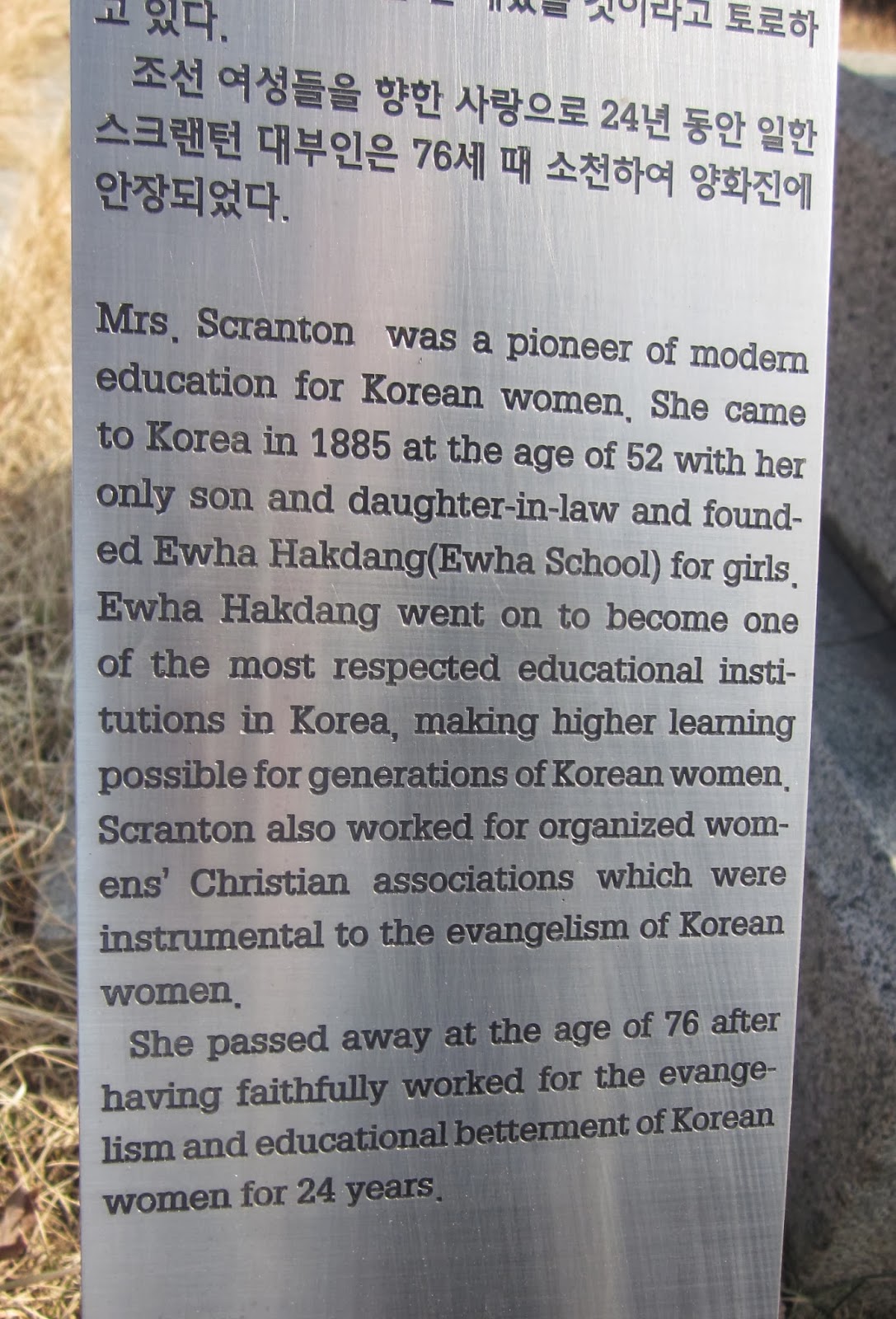
M. F. Scranton, a pioneer of education for women in Korea, came to Korea at the age of 52, from the USA. She passed on at the age of 76, having dedicated herself to spreading the Gospel and the betterment of Korean women for the last 24 years of her life.

Friday, March 25, 2016

Applications For The WRAP Are Now Accepted


In school, there is no shortage of what to learn. 
The shortage is why.


Followers of Christ in the United States are coming to the sober realization that the biblical foundations for law, civil government, economics, and family that once provided commonly accepted harbor lights for society have been replaced. An incessant move toward the secularization of society and the privatization of Christianity that took place in the 20th Century was enormously successful, being expedited through elementary and secondary schools.

My biggest concern about young Christians being indoctrinated through secularized education is not that they will become atheists. My biggest concern is that they will become Christian dualists. Even inadvertently through unwary Christian schools.  

A Christian dualist is one who sees the Bible as relevant to one's personal life, or to the affairs of the church, but not relevant to what goes on in the Monday-through-Friday workplace. Christian dualists don't mix the biblical world-and-life view with driving a truck, painting a house, or managing a bank, because they didn't mix it with biology, art, or math. Regrettably, the reason many Christian schools don't practice this is because the teachers have not been taught how. It is a learned skill that is not included in the teacher training programs of universities today. 

Worldview Matters is on a mission to restore a biblical view of work and human flourishing to the Christian school curriculum, from preschool through high school, so students are equipped to engage in something grand, beyond themselves, yet in the here-and-now, by engaging in work of all kinds, both present and future, as the very work of God.

The Worklife Restoration and Advancement Project, or as we like to call it, the "WRAP," is a vigorous program for whole schools, not just individual teachers. Applications for the WRAP are now accepted for the 2016-17 school year. The number of schools we are able to accept into the WRAP is limited. Early applicants have a better chance of receiving funding. Applications are due May 1.

For more details, and to obtain a WRAP Application Form, click here.

If the links in the above document do not work for you, request another version directly from info@worldviewmatters.com.

For a short video clip about the vision and purpose of the WRAP, click here.

Feel free to pass this information on. We are accepting applications from any nation, but currently the training is only available in English. [A Spanish edition is in process, but not ready yet.]