test
A Publication of RenewaNation: Helping Children Develop a Biblical Worldview.

To Link To The RenewaNation Website


Friday, September 23, 2011

It Happens Tomorrow Morning

Events that strengthen our ability to integrate Christian truths with daily work are proliferating. While it is good to have help in strengthening one's marriage, increasing parenting skills, practicing evangelism, and being wise in handling personal finances, it is also a blessing to have assistance in connecting the biblical worldview with our work.

One such event is a nationwide webcast with Chuck Colson, called, Doing the Right Thing: An Exploration of Ethics. It happens tomorrow morning, September 24, 8:30am - 12:30pm. In addition to Chuck Colson, other speakers include Del Tackett, known for his work with the popular Truth Project, John Stonestreet, of Summit Ministries, and Robert George, of Princeton University.

For details, including locations of participating churches and schools, click here.

Then on Saturday, October 8, Faith and Work Life, a not-for-profit organization that is committed to helping men and women connect their faith life and their work life, will present the 4th Annual Faith At Work International Conference. This free event will be held on the campus of Concordia University, in Irvine, California. Distinguished speakers include David Kim, CEO of Baja Fresh and Sweet Factory, Bob Doll, Vice Chairman of Fundamental Equities, Court Durkalski, CEO of Truline Industries, Wendy Flint, Senior Vice President Marketing & Sales, Boston Reed, and more! For details and registration, click here.

Another special event of note is the Work As Worship Conference, to be held on November 3, in Dallas, Texas. This event is for CEO's, young entrepreneurs and business leaders who are passionate about combining business with ministry. Speakers include Bill Peel, Director of the LeTourneau University Center for Faith and Work, and David Greene, CEO of Hobby Lobby, among others. For details and registration, click here.   

For those on the East Coast, consider attending the first Gospel & Culture Conference, hosted by the Center for Faith & Work at Redeemer Presbyterian Church, New York City, on November 4-5. This event is the fruit of Redeemer's eight year investment in faith and work ministry (one of the few churches in the nation  that has such a program).

The focus of Redeemer's Gospel & Culture Conference is on seeing how God is at work in the world, and how His work informs the way we understand our own work. For details and registration, click here.


For those of you who live in Western Washington, note the webcast locations shown on the RH panel above. All gatherings at these locations are free. (Left-click on the image to enlarge it.)

Bookmark and Share

Friday, September 16, 2011

Paul Says The Opposite

"Set your mind on things above, not on things on the earth." (Col. 3:2)

How does this fit with God's First Commission to govern over the earth? (Gen. 1:26-28) Setting my mind on things above? Not on things on the earth? If I'm building houses, running a bank, or selling life insurance, I have to think about things on the earth, don't I?

But if we take a close look at the context of Col. 3:2, reading verses 1-14, we see that when Paul speaks of the "things on the earth," he is not referring to our jobs, our lawnmowers, or our checkbooks:

"If then you were raised with Christ, seek those things which are above, where Christ is, sitting at the right hand of God. Set your mind on things above, not on things on the earth. For you died, and your life is hidden with Christ in God. When Christ who is our life appears, then you also will appear with Him in glory. Therefore put to death your members which are on the earth: fornication, uncleanness, pasion, evil desire, and covetousness, which is idoloatry. Because of these things the wrath of God is coming upon the sons of disobedience, in which you yourselves once walked when you lived in them. But now you yourselves are to put off all these: anger, wrath, malice, blasphemy, filthy language out of your mouth....Therefore, as the elect of God, holy and beloved, put on tender mercies, kindness, humility meekness, longsuffering; bearing with one another, and forgiving one another, if anyone has a complaint against another; even as Christ forgave you, so you also must do. But above all these things put on love..." [NKJV]

The "things above," upon which we are to set our minds, are "tender mercies, kindness, humility, meekness, longsuffering...etc."

The "things on the earth," upon which we are not to set our minds, are "fornication, uncleaness, passion, evil desire, convetousness...etc."

Paul then goes on to pen some of the most significant words in the New Testament pertaining to work on this planet: "Whatever work you do, do it with all your heart. Do it for the Lord and not for men." (verse 3:23, NLV)

Rather than suggesting that we not focus our mind on our earthly work, Paul says the opposite. We are to apply our whole heart to whatever work we do, as working for Christ Himself!

Bookmark and Share

Friday, September 9, 2011

Fallen Creatures In A Fallen World

"Do not love the world, or the things of the world." (I John 2:15)

How does this fit with God's command to "subdue the earth?" (Gen. 1:28) Is it wrong to love our work as helicopter pilots, car mechanics, homemakers or CEOs?

Consider four meanings for the Greek word "kosmos" in the New Testament, translated "world" into English:

1. Populated regions. As in Romans 1:8, "I thank my God through Jesus Christ for you all, that your faith is spoken of throughout the whole world [kosmos]."

2. The human race in general. As in John 3:16, "For God so loved the world [kosmos] that He gave His only begotten Son, that whosoever believes in Him should not perish, but have everlasting life." We have a big problem if we take the word "world" in I John 2:15 to mean "the human race."

3. The created realm. As in Romans 1:20, "For since the creation of the world [kosmos] His invisible attributes are clearly seen, being understood by the things that are made, even His eternal power and Godhead, so that they are without excuse."

4. A system of thought and behavior that is contrary to the will and ways of God. As in Colossians 2:8, "Beware lest anyone cheat you through philosophy and empty deceit, according to the traditions of men, according to the basic principles of the world [kosmos], and not according to Christ."

If we read I John 2:15 in the context of verses 16-17, we see John is actually exhorting the reader to love not the "world system." He is talking about not loving thought or behavior that is contrary to the will and ways of God.

In verse 16-17 John amplifies this meaning of "the world" as "the lust of the flesh, the lust of the eyes, and the pride of life." It is this "world" that we are to not love.

If our work feeds lust and pride, then this is a problem. We need to change our attitude, not necessarily our job. However, in some cases, we may need change our job, too! It depends on what the job is. Work centered around ungodly pride, power or greed is a problem.

We are to be in the world [populated regions, created realm], but not of the world [that system of thought and behavior contrary to Christ].

This is the challenge of everyday work for fallen creatures in a fallen world.

Bookmark and Share

Friday, September 2, 2011

A Rainbow Of Jobs

Happy Labor Day weekend!

Why should we celebrate work? Because work is an opportunity to fulfill the role God had in mind for humans when He made us in the beginning: “Let us make man in Our image, according to Our likeness…and let them rule…over all the earth.” [Gen. 1:26-28]

This remarkable responsibility (I call it, the “First Commission”), covers a lot of ground. Literally! It necessitates a rainbow of jobs: earth-moving, bridge-building, skyscraper-making, ship-building, dam-constructing, fish-managing, potato-planting, truck-driving, log-cutting, house-building, bed-making, wall-painting, car-fixing, grocery-shopping, money-managing,  coffee-grinding, cake-baking, music-making, dish-washing, lawn-mowing, hair-cutting. You get the picture.

Our great challenge is to do these things in sync with the Lord of our labor. Our Employer. It’s His stuff we are managing, grinding, mowing and molding. It’s His Commission we are living out. It’s His world we are stewarding―fallen and broken though it be.

God did not abandon this planet when Adam sinned, nor did He give the world over to Satan’s ownership or authority when Adam and Eve fell from grace in the garden. The earth and all it contains remains God’s own possession [Ps. 24:1], and He continues to hold it together by the word of His power [Heb. 1:3], sustaining it through time and space [Col. 1:16-17].

Satan’s offer to give Jesus "the Kingdoms of the world” [Luke 4:5-8] has led many to think that this world was Satan’s to give away. Nothing could be further from the truth! Satan’s choice of words on that occasion was masterful. Masterfully misleading, that is! I’ll explain why I say this in coming weeks.

But before I do, I have a question for you: How can a celebration of labor fit with Paul's admonition to "love not the world, nor the things in the world?"

How can a follower of Christ really celebrate work, if that work―be it car-fixing, cake-baking or coffee-grinding―is so closely associated with this present world, which we are not supposed to love?

Hummm....What gives here?

What gives is an enormous amount of confusion over the term "world." On the one hand, we have Paul exhorting us to "love not the world," and on the other we have John telling us, "God so loved the world that He gave His only begotten Son..."

Our confusion lies in the fact that the term "world" [kosmos, in Greek] has four different meanings in the New Testament!

Hang on. This is important. 


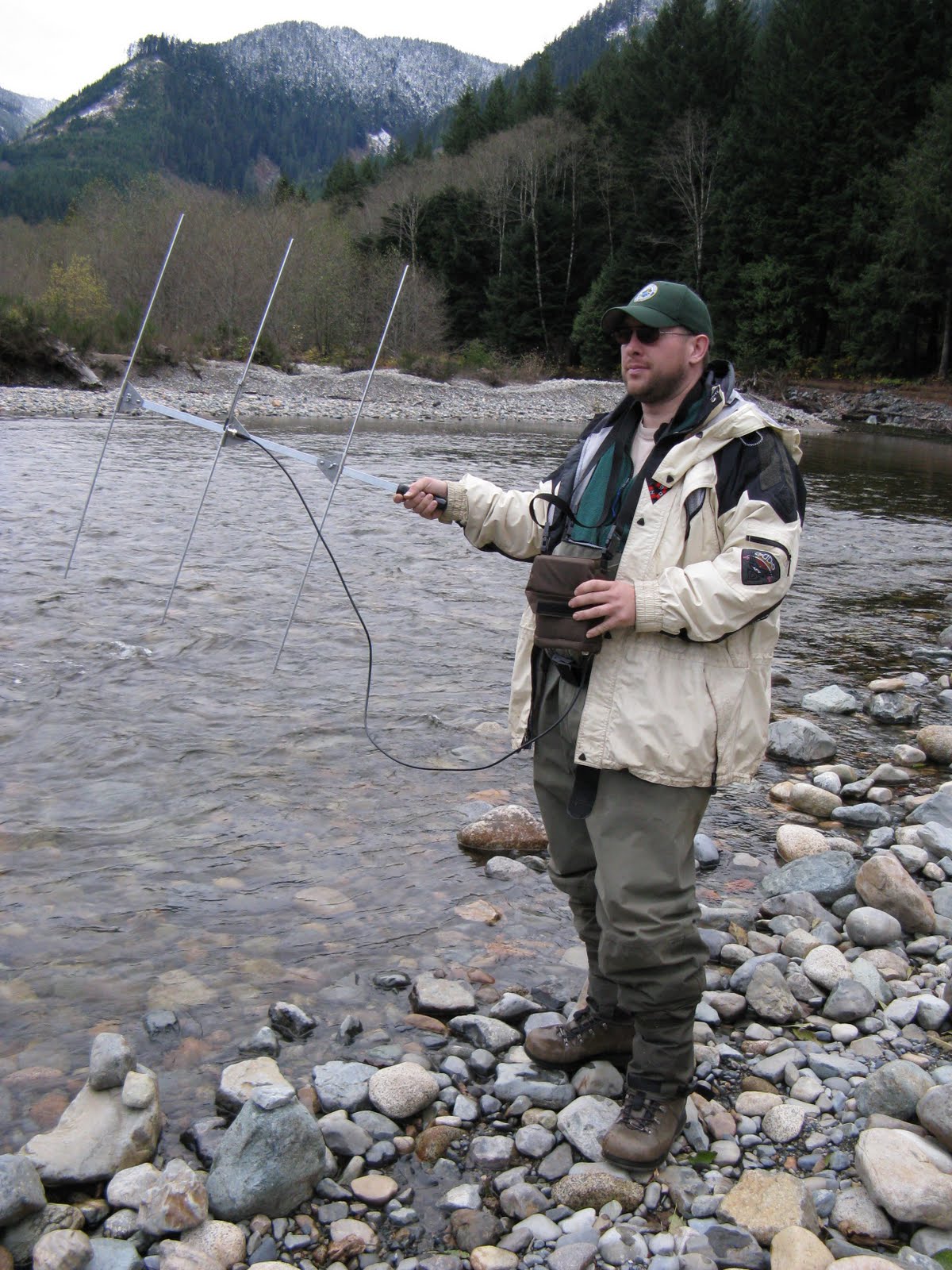
This is a photo of our son, Nathanael, doing the work of the Lord
by engaging in the First Commission of Genesis 1:26-28
through radio-tracking tagged trout on a research project for the
State of Washington. When I say Nathanael is doing the
work of the Lord, I am totally serious. This is what God had in mind
when He created humans. This is what God still has in mind
for humans. Nathanael is fully cognizant of this role,
and loves his work. He does it in a way that honors God,
and he does it "as unto the Lord." Today, he serves Christ
as a biologist for a major power company in the Pacific Northwest,
working on the interface between power needs and fish needs.

Bookmark and Share

Friday, July 15, 2011

To Reconcile Not Only People But Things

One of the greatest joys of work is rest. With this in mind, I’m taking the next six weeks off from blogging!

Before signing off, I'd like to share one more helpful tool for eradicating the "SSD virus."

The Sacred-Secular Divide looks like this:


The “sacred” activities of life include things like Sunday morning worship, Bible study, prayer, witnessing, volunteering at the homeless shelter, and going on mission trips. These activities have real significance, because they truly matter to God. They have to do with the “things above,” which we should be "setting our minds upon."

"Secular” activities don’t have as much significance. They include things like mowing the grass, earning money to keep a roof overhead, and paying electric bills. These things simply aren’t as important to God. They may be necessary, but they fall under the category of “things of earth” that should "grow strangely dim" with each passing day.

Here is what to do with that way of thinking:


Substitute this:


Any sphere of human activity may be done in harmony with God or in conflict with Him; in alignment with Him, or in opposition to Him. God's game plan is to reconcile not only people but things to Him.

Things! Things on earth! (See Colossians 1:16-20.) Business things! Legal things! Artistic things! Civil things! Yes, "that in all things He may have the preeminence...." (v. 18)!

“...since there is nothing which stands outside of His authority, He is as relevant to what goes on in civil government as He is to the way business functions, to the way family members relate to one another...to the way a local church functions. In short, He is Lord of all, and no less relevant to one area of human endeavor than another..." [Assumptions That Affect Our Lives, pp. 112-113]

So let's resist withdrawing from God's physical, here-and-now world. It's all His (Psalm 24:1)! We have a responsibility toward it. By God's grace, let's engage with it rightly. Let's celebrate the dance! Please view Detachment from Matter.

But doesn’t the Bible say, “Set your mind on things above, not on things on the earth?” And, “Love not the world, nor the things in the world?”

I’ll pick up from here in September.

Bookmark and Share

Friday, July 8, 2011

If You Read Only One Book This Summer

If you are a regular reader of this blog, you know I have been focusing lately on the challenge of ridding ourselves of SSD, the Sacred-Secular Divide. I liken the process to a 600-pound man losing 420, because shedding SSD takes continued focus and repeated choices. 

There are some things we can do to help the process. I recommend reading what others have to say about the problem of dualism. I have already mentioned Nancey Pearcey’s book, Total Truth. In addition, I recommend Creation Regained, by Albert Wolters, The Integrated Life, by Ken Eldred, and Job-Shadowing Daniel, by Larry Peabody. Your Work Matters To God, by Sherman and Hendricks, is also very helpful, and The Other Six Days by R. Paul Stevens, is a classic.

I also recommend Assumptions That Affect Our Lives. The seventh edition of this book is now being printed, and the feedback I continue to receive on this book has been the most rewarding aspect of my work in the past twenty-two years since writing it. 

There are few books that deal solely with the problem of SSD. That’s why I’m pleased to let you know about a new book on this topic, published by YWAM Publishing, titled, Beyond the Sacred-Secular Divide. It is masterfully written by Scott D. Allen, President of Disciple Nations Alliance.

I was asked to preview Allen’s book, and below is my endorsement:

“While reading this book, at times I felt like weeping. I wasn’t sure why, until I got to the last paragraph: ‘We are living at a kairos moment in church history—a pivotal time where old paradigms are giving way and new ones are emerging.’ I then knew my spirit was weeping with God, in a rare combination of relief, joy and hope. Scott Allen has done a masterful job of pulling the important pieces together into one place. His book will remain in my top ten list of ‘game changers’ for a long time to come. My copy is highlighted throughout, with explanation points, arrows and smiley faces.”

If you read only one book this summer besides the Bible, let it be Scott Allen’s Beyond the Sacred-Secular Divide. Order from Disciple Nations Alliance here.


Bookmark and Share

Friday, July 1, 2011

The Meaning Of Work Worth Doing

In ridding ourselves of SSD [the Sacred-Secular Divide], it helps to keep the meaning of work worth doing in mind. (Not all work is worth doing. It takes work to rob banks, but that’s not work worth doing.)

Here’s a definition of “work worth doing” that I have taped above my computer display:

“Work worth doing is any expenditure of energy, mental or physical, for pay or not, that rightly manages God’s stuff (tangible or intangible), and employs my God-given abilities to benefit others (directly or indirectly), or prepares me to do so.”

God's tangible stuff includes wood, metal, cloth, and electricity. His intangible stuff includes language, numbers and ideas (all truth is God's truth). Doctors and nurses benefit people directly, while loggers benefit people indirectly. This definition applies to children, students in school, adults in the workforce, and retired folk. It applies to work at home and work outside the home; to the kitchen as well as the courthouse. [FYI, I’ll be doing a free on-line 90-minute webinar on October 18, called, “Kitchen and Courthouse: Bring Meaning To Life.” To reserve your place, go to www.highpurpose.blogspot.com. Space is limited.]

The part about “managing God’s stuff rightly” is a reference to the First Commission of Genesis 1 (to govern over God’s creation as His vice-regents), and the part about “benefitting others" is a reference to the Great Commandment of Luke 10 (to love our neighbors as ourselves).

In short, work worth doing carries out the First Commission in keeping with the Great Commandment.

Is your work worth doing? Ask yourself: 

#1. “What part of God’s stuff (tangible or intangible) am I managing, cultivating, or governing rightly?”

#2. “How does this work directly or indirectly benefit people?”

#3."If my work does not do these two things now, how is it preparing me to do so in the future?”


Any work that benefits others (directly or indirectly) while managing God’s stuff rightly is work worth doing, whether it’s building airplanes for the Boeing Company, or cooking healthy meals for one's family.

I recommend putting this definition of work on your computer display, if you govern over language or numbers, or tape it inside your lunch box, if you govern over lumber, or drive a FedEx truck.

When it comes to bringing extraordinary meaning to ordinary work, it helps to keep the meaning of work worth doing in mind. 

Bookmark and Share

Friday, June 24, 2011

Whatever You Had For Breakfast This Morning

One way to be cured of SSD [that mental virus called the Sacred-Secular Divide] is to fully recognize God at work around us every day. I’m not just referring to Him keeping the earth spinning at 1,038 mph at the equator, but the fact that whatever you had for breakfast this morning was the result of God at work, too.

I’m not just referring to Him providing the sunshine that enabled your cornflakes to be. I’m also thinking of how He worked through so many people to get it to your bowl. You see, God could have chosen to deliver your food to your front door by Himself, fully prepared. But instead, we see a long human chain that links the farmer to the soil, the truck driver to the marketplace, and the grocery clerk to the cash register. All along the way, from one end of the chain to the other, humans are engaging in the First Commission, whether they realize it or not.

If we continue to follow the chain out the grocery store door, we find men and women who spend 40-80 hours a week at thousands of jobs that generate the dollars paid at the cash register. If we go back to the other end of the chain, where the farmer meets the soil, we discover things that only God can do (like creating sunshine, plants and water), but this doesn’t mean His work is done through photosynthesis alone. God does His work through truck drivers, grocery clerks and bankers.

As humans, we were created to co-work with God, by ruling over raw materials He alone sustains, shaping and molding them (as only image-bearers of God can do) into cornflakes, oatmeal and french toast. Milk comes from cows and grass that God alone sustains, but the process God uses to give you your breakfast is a delightful dance between Himself and human beings.

God sustains the milkman, and the truck. The butcher and the baker, too. These are all means by which God fulfills His purpose for food, His love for people, and His intention for human beings to govern over creation, using the gifts and abilities He provides. That’s what work is all about.

Secular jobs? Think again. The Hebrew word for "work" and "worship" is the same word. Click: avodah.

Bookmark and Share

Friday, June 17, 2011

Ahhhhhhh...

I don’t think we’ll know the complete answer to why God created humans until we cross through to the other side. Then I think we’ll all look back and say, “Ahhhhhh….”

Thanks to Scripture, we know how we came to be. (Yes, I do believe God formed Adam out of dirt. That doesn’t sound very flattering. The “dust of the earth” sounds better. But not by much.) Yet, this doesn’t answer the really big question: Why did God create humans?

The answer I have heard all my life is: “We were created to glorify God and enjoy Him forever.” But this answer has never fully satisfied me. So, I’d like to tweak the question a bit: What role did God have in mind for humans when He created us?

This is much easier to answer, because the Bible tells us exactly what role God had in mind for us to play. His intention from the beginning was for us to govern [steward, rule, have dominion] over Earth and all it contains. Genesis 1:26-28 doesn’t tell us much about the why, but it sure does tell us the what!

This is truly mind-boggling. God created human beings to rule over His creation! I like the way Chuck Colson put it: “On the sixth day, God created human beings—and ordered them to pick up where He left off!” That’s quite a responsibility—and a great honor. Talk about purpose!

This satisfies me. It gives me purpose in mowing my lawn, and ridding it of moles (one of the greatest challenges to human governance known to man, and a sure sign of the curse). It brings meaning to taking trash to the garbage cans, and cleaning drains on the roof. It gives me joy in writing, speaking, consulting and coaching. When I do these things rightly, I feel God's pleasure, like Eric Liddell running a race.

Of course, not every moment is a pleasure. Sometimes I bump into pain that comes with a broken world. Sweating isn't fun. Nor are moles. But I always come back to the realization that I was made for a reason, and I can engage in the call of the First Commission with satisfaction, when building a backyard chicken coop with a friend, or collecting eggs the fowl produce.

Farewell SSD.


Stewarding our four faithful egg-makers.
Which came first? The chicken!
A sure sign of the curse: moles.

Bookmark and Share

Friday, June 10, 2011

The Earthiness Of The Great Commission

To be cured of SSD [the Sacred-Secular Divide], it helps to take another look at the Great Commission of Matthew 28:18-20. Revisiting the Great Commission is a healthy thing to do now and then, because it defines the missional identity of the Church.

The Great Commission has a very “earthy” focus. That is, its focus is more on the here-and-now than life-hereafter. Yet, as a child growing up in the church, I translated it this way: “Go everywhere to save souls, so people can go to heaven when they die.”

The Great Commission doesn’t say “make converts,” although baptism certainly implies this necessary step. What it says is: “make disciples.” It doesn’t talk about teaching people to ask Jesus into their hearts, but “teaching them to observe all that I [Jesus] have commanded you.” This observation takes place on Earth, as we are "going."  

In the Great Commission, Christ doesn’t say, “I’ll see you in heaven,” but “I’m with you on earth—‘till the end of the age.” It is the earthiness of the Great Commission that links it so powerfully with the First Commission of Genesis 1:26-28. The Great Commission of Matthew 28 focuses on what happens here, where God wants His will to be done—as it is in Heaven. Jesus is Lord of both realms at once [v. 18].

God has an earthly intention for human beings, and this intention is stated in the first chapter of the Book: to rule over all creation. This involves flying helicopters in logging operations, managing salmon, manufacturing light bulbs, designing software, cutting hair, rearing children, and making breakfast.

The Great Commission is about people everywhere [all nations] observing all He has commanded, in the context of wherever we go. For half our waking hours, this is where we work.

One of the best writings I have seen on the unity of the two commissions [the First and the Great] is in Chapter 6 of Liberating the Laity, by R. Paul Stevens: “Because man failed to keep the first mandate [Genesis 1:26-28], God gave us in Jesus the missionary mandate [Matthew 28:18-20]…But what is seldom understood is that God gave us the second mandate in order to restore the first…We are saved in order to fulfill God’s original intention.”

This leaves no room for the Sacred-Secular Divide.

Bookmark and Share

Friday, June 3, 2011

The Most Important Occupation Jesus Could Have

When it comes to ridding ourselves of SSD [the Sacred-Secular Divide], it would be helpful if the First Commission [Genesis 1:26-28] was given as much weight by Christian writers, singers, teachers and preachers as the Great Commission [Matthew 28:18-20]. Yet, making this suggestion may cause me to be viewed by some as a heretic.

I can hear it now: “Which is more important, Overman? Flying helicopters to lift trees out of forests so logs can be cut into lumber for building homes, or saving souls?”

But positing this question dichotomously as an "either-or" proposition is like asking, as Al Erisman, co-founder of the Center for Integrity in Business, does: “Which wing of an airplane is more important?”

I still hear push-back: “Which is more important, a house built of wood, or mansion in heaven?”

My response is: “More important to whom?”

If I answer the question from the perspective of my own self-interests, a mansion in heaven is more important than a house on Earth. But if I consider the question from the perspective of God’s wholistic interests, I come up with a different answer.

What am I getting at? I suggest we remember Mary’s words to the servants at the wedding of Cana: “Whatever He tells you to do, do it.” Isn’t that our sacred task? As those servants filled pots with water, were they not doing the Lord’s work? 

For eighteen years, the most important occupation Jesus could have was to build furniture and plows, because this is what His Father showed Him to do. Justin Martyr, in the second century, said plows made by Jesus were still being used in Martyr's lifetime. Good workmanship!

The work God wants us to do includes earth-tending and culture-creating. For some, the work of God may be preaching, for others it may be sawing logs into lumber. That's because God wants people to be protected from the elements, and He uses humans to make the shingles. He wants lumber to be moved from point A to point B, and uses truck drivers to do the transporting.

Perhaps the most helpful thing in ridding ourselves of SSD is to view the First Commission and the Great Commission as a single unit. As Paul Stevens wrote in Liberating the Laity: “God gave us the second mandate in order to restore the first.”

We’ll pick up from here next week.

Bookmark and Share

Friday, May 27, 2011

How Flying Helicopters Is A Way To Really Serve The Lord

Not long ago, I had a conversation with a young man in my office I’ll call “Jason.” He is in his early 20s, a committed follower of Christ, and a graduate of Bible school.

Jason loves to participate in street evangelism. His greatest thrill in life is to lead someone to the Lord. Wonderful! A remarkable young man.

When I ask him what profession he wants to pursue, Jason turns his head to the side, looks up at the ceiling, utters the words "Forgive me Lord,” and then (looking me straight in the eye), declares: "I want to fly helicopters."

Flying really interests Jason, and he's particularly fond of helicopters. He loves everything about them. He tells me he wants to lift logs out of forests, in logging operations. Yet, it is evident Jason feels tension in his life because he doesn’t see how flying helicopters is a way to really serve the Lord.

I ask Jason if he is aware of the First Commission. He says he hasn’t heard of the First Commission, so I turn his attention to Genesis 1:26-28. Here is how it reads in The Message:

God spoke: "Let us make human beings in our image, make them
      reflecting our nature
So they can be responsible for the fish in the sea,
      the birds in the air, the cattle,
And, yes, Earth itself..."
     He created them male and female.
God blessed them:
     "Prosper! Reproduce! Fill Earth! Take charge!..."

The Amplified Bible translates verse 28 like this: “And God blessed them and said to them, Be fruitful, multiply, and fill the earth, and subdue it [using all its vast resources in the service of God and man]…”

I shared with Jason how flying a helicopter in logging operations fits beautifully into the fulfillment of our job description, to steward God's creation. He could directly serve God and indirectly love people by lifting trees from forests so they can be hauled to mills and cut into lumber for building homes.

Jason's face lit up. He had an epiphany. "I never thought of that!" he said. He suddenly saw a way to participate in the First Commission of Genesis 1:26-28 and the Great Commission of Matthew 28:18-20. Both. 

He seemed to shed 420 pounds in an instant.

Using all its vast resources in the service of God and man...Take charge!

Bookmark and Share

Friday, May 20, 2011

Like Shooting A Few Sacred Cows

The Sacred-Secular Divide is a mental problem that affects us more than we realize. Mark Greene calls it, “SSD.” Sounds like a disease, doesn’t it? Dr. David Scott, a professor of theology at Southern Evangelical Seminary, calls it a “mental virus.” See his essay, A Church Without A View.

It doesn’t sound very nice to say it, but we really do have a mental problem. The “virus” is so deeply embedded in our brains that we assume the Sacred-Secular Divide is a normal, natural, and even necessary way of thinking.

This is a huge part of the problem. We think this way of thinking is normal! Some may even like the Sacred-Secular Divide. It might feel good to be known as a person who is “in full-time Christian ministry.” It has a nice ring to it. Many have done a lot, given up a lot, or paid a lot to earn that distinction. Others dream about it. “Someday,” they think, “I will quit my job (or retire) and go into the ministry.” 

Go into the ministry? What does that mean? Aren't we "in the ministry" wherever we go?

Was Jesus "in the ministry" during the eighteen years He spent as a carpenter? Was He doing what His Father showed Him to do during those years as much as the last three? Actually, Jesus was in the ministry of carpentry. And this is no joke.

Nearly 500 years ago, Martin Luther tried to rid the church of the notion that some people have “special” calls: “Monastic vows rest on the false assumption that there is a special calling, a vocation, to which superior Christians are invited to observe the counsels of perfection while ordinary Christians fulfill only the commands; but there is simply no special religious vocation since the call of God comes to each at the common tasks.”

For Luther, such common tasks included milking cows and changing babies’ diapers. These things, too, are “the Lord’s work.” But if you or I were to ask one hundred Christians to give six examples of “the Lord’s work,” I doubt if milking cows would be mentioned.

Speaking of cows, I’m convinced that ridding ourselves of SSD requires some hard decisions, like shooting a few sacred cows. While the thought of shooting cows may be unpleasant, I think it's necessary.

To be continued.

Bookmark and Share

Friday, May 13, 2011

The Most Important Talk At Lausanne

"We honor, celebrate and tell stories about pastors, preachers, worship leaders, missionaries and social activists,” Mark Greene told his audience at the Third Lausanne Congress on World Evangelism, in Cape Town last October, “but we almost never hear stories about cleaners, or bus drivers, or lawyers, or bankers, or politicians."

Why is this the case?

Greene, a leader in the marketplace movement, told his Cape Town audience that we have a “systemic” problem: "The good seed of the marketplace movement,” he declared, “is being planted in poor soil. So it will not matter how much we water that soil, or how diligently we seek to nurture the seed, how we protect the plant from disease. The soil is deeply affected by the Sacred-Secular Divide."

This is the truth. The church has been so infected by “SSD,” [Greene's shorthand for the Sacred-Secular Divide], that no matter how much we try to nurture the marketplace movement, it can’t blossom as long as the soil in which it is planted is leached of nutrients.

“We may know in our heads that the Gospel embraces every area of life,” Greene said, “but this is not the Gospel we have been teaching people to live, or celebrating when they do.”

"There are two strategies to reach the world,” Greene maintains. “The first one is to recruit the people of God to use some of their leisure time to join the missionary initiatives of church-paid workers. And the second one is to equip the people of God for fruitful mission in all of their life.”

The first strategy has been the predominant approach of evangelical churches for decades. The second is in need of reformation through elimination of the "SSD" problem.  

Greene, the author of Thank God It's Monday, is the Executive Director of the London Institute of Contemporary Christianity. This organization, founded in 1982 by John Stott, is based on the premise that “every part of our lives comes under the Lordship of Christ, and that all of life is a context for worship, mission, ministry and active Christian engagement."

Bill Peel, co-author of Going Public With Your Faith, and Executive Director of the LeTourneau Center for Faith and Work, says Geene’s Cape Town speech, “may be the most important talk at Lausanne.”

Watch an edited version here: People At Work.

Bookmark and Share

Friday, May 6, 2011

The Neverland Of Our Times

When Luke (under the inspiration of the Holy Spirit) wrote, "He is Lord of all" (Acts 10:36), I don't think he meant to imply that Jesus is just Lord of all who believe He is Lord. The fact is, Christ's authority applies to everyone, whether His authority is recognized or not. 

Christ is the Head of the University of Washington whether the Board of Regents acknowledges Him as such or not. If the Board has any authority at all (and it does), it is only because God grants it authority. Jesus made this clear at His own trial, when He said to Pilate, the Roman governor of Judea, "You would have no authority over Me, unless it had been given you from above." (John 19:11)

So when we add up the fact that the universe is held together by the command of Christ, and that everything and everyone on the planet is owned by Him, and that all authority is given unto Him in heaven and earth, the only thing I can conclude is, the "secular world" is the Neverland of our times. We have talked about it so long we think it is actually there. But where exactly is this place?

The word secular comes from the Latin word saeculum, meaning an "age," or "long period of time." At one time, this word may have distinguished the temporal, time-bound realm from the eternal, but today the word goes far beyond that. It connotes things detached from God's business, existing outside the realm of His affairs, interests and authority. But the truth is, we can't get away from His business, interests or authority, no matter how hard we try. Even, as King David said, if we dwell in "the uttermost parts of the sea." (Psalm 139)

I suggest we drop the word "secular" altogether, and substitute the word "secularized." While we don't live in a secular world, we do live in a world that has been secularized by humans. There are no secular jobs, but many secularized jobs. The University of Washington is a secularized place, but not really a secular school.

Words can send unintended messages. Every time we use the word "secular" we reinforce the idea it exists. This makes it hard to eliminate the "sacred-secular distinction," as Nancy Pearcey describes it. So let's quit making the distinction altogether. 

See Where Exactly Is The Secular World?: http://youtu.be/gPPh3FCRlnc

Bookmark and Share

Friday, April 29, 2011

I Saw Walking Miracles

As a young man attending the University of Washington, I was one of 35,000 students. While our minds were busy with academic pursuits, inside every chest was a pump that expanded and contracted 100,000 times a day without a thought. Made of tiny vibrating loops of energy first set in motion by the voice of God, these fleshy little drivers kept us going even during sleep, whether in class, or in bed. 

Every professor's brain contained more cells than stars in the known universe. The electrochemical communication that flowed among 100 billion neurons allowed each instructor to do their work. Whether atheist, agnostic, or saint, each was continuously held together by the sustaining power of Christ's word (Heb. 1:3). He gave us all breath, 14,000 times a day.

Christ kept sustaining us, quarter after quarter (Heb. 1:1-3; Col. 1:16-17). God owned us, professor and student alike (Psalm 24:1). All around me at the University of Washington, I saw walking miracles, each created in the likeness and image of God (Gen. 1:26-27). What is secular about all this? Nothing.

And then there was the campus itself. Evergreen trees and rhododendron plants were everywhere. Cherry trees pinked each spring like clockwork. And the buildings! They, too, were made of vibrating loops of energy set in motion by Christ's voice, reverberating since the beginning, as a continuous symphony.  

I have never seen a secular building in my life. Ugly ones, yes, because we live in a fallen world where people do some hideous things with God's stuff, but never secular ones. Each one is made entirely of God's stuff alone, sustained through Christ's command, put together piece by piece by image-bearers of God.

I spent about six years at the University, earning two bachelor's degrees. One in music, and the other in German language and literature. Neither subject was a secular subject. Why? Because God created and sustains sound waves and eardrums. He also gives humans the amazing capacity to think abstractly, speak and write language. Music was His idea, and so is language. What's secular about that?

There is no secular subject at the University of Washington, because if it has anything to do with time, space, or matter, it's all the stuff of God. Furthermore, the University of Washington can never be a "secular school," because its Head is Christ.

Say what?!!

I'll pick up from here next week.


The best thing that happened during my time at the University of Washington was meeting a remarkable walking miracle by the name of Kathy Marie. She earned her Mrs. degree in just two years! (Brilliant woman.) This photo was taken on the U.W. campus, about four months before we tied the knot, nearly 41 years ago.

Bookmark and Share

Friday, April 22, 2011

Where Exactly Is The Secular World?

As a footnote to last week's post, let me add something here: to say that God is continuously sustaining all the elements of the universe is not to say He controls every human act.

To sustain and to control are two different things. If I punch you in the nose, I trust you won't think God made me do it. While He will sustain my fist if I choose to connect it with your face, don't assume He is causing me to swing, or that this particular act was planned by Him from the foundation of the world. God gives His image-bearers, as Thomas Aquinas put it, "the dignity of causality."   

While God is in a position of absolute control (that is to say, if He wanted to, God could turn my arm into Jello before impact, or send an angel to divert my aim), He does not control every act of humanity absolutely. I know I'm wading into controversial waters here, but the idea that everything that happens is "the will of God" is fatalism.

Back to the "sacred-secular split."

The second big help I've found in shedding the "sacred-secular distinction," is the acceptance of God's universal ownership. That is, the earth and everything in it belongs to Him. Not just the mountains, the rivers and the apple trees, but the ring on my finger, the shirt on my back, and the roof over my head. All the oil in every reserve, all the gold in Fort Knox, and whatever you may have in your checking account is His, along with all the cars on the freeway, the jets in the sky, and every person who drives or flys them.

"The earth is the Lord's, and all it contains, the world and those who dwell therein." [Psalm 24:1] This is God's world! Furthermore, He gives every human breath (Job 12:10), and "in Him we live and move and have our being (Acts 17:24-28)." 

So where exactly is the secular world?

Yet, as a student at the University of Washington, I attended a "secular school," didn't I? When I worked during the summers unloading box cars on the Seattle waterfront, I had a "secular job," didn't I?

Well...no. I'll explain why next week.

Bookmark and Share

Friday, April 15, 2011

String Theory And The Voice Of God

A good starting point for ridding oneself of the “sacred-secular split” is to accept the premise that the entire universe is sustained, day after day, by the command of God. Not only did Christ make everything out of nothing, but He continues to maintain every atom through time. 

Col. 1:16-17 tells us, “In Him, all things consist [cohere, are held together].” In Hebrews 1:1-3 we read how the Creator-Sustainer does this. It says that Christ, "through whom God made the world," upholds all things "by the word of His power.”

“By the word of His power?” What’s that all about? Is the Bible saying that the power holding all things together is Christ’s command? His utterance? His speech?

Hummm....

In Genesis 1, we read the universe was spoken into existence: “And God said, ‘Let there be…,’ and there was…” Sounds like God created everything via His voice to me. But, some may ask, “Isn’t that just poetic language?”

Maybe so. Maybe not. Maybe both.

Scientists tell us if you break matter down to its smallest components, you'll find atoms. If you break atoms down, you'll find quarks. It’s just a theory, mind you, but some scientists tell us if you break down quarks, you'll find “vibrating loops of energy,” called “strings.” The rate at which these “strings” vibrate determines the specific quality of the particular element in which the vibrating loops reside.

Could these vibrating loops of energy be the continuing reverberation of the voice of God, vibrating since His first creative command?

Einstein tried to formulate a “unified field theory” that would encompass both big-world physics (gravity and galaxies) and itty-bitty-world (sub-atomic) physics. A theory that would unify the diversity and complexity of everything. He never did figure it out.

I’m no Einstein, but this formula makes perfect sense to me:

U = (v + i) p

Where U = the Unified Field, v = the voice of God, i = the intelligence of God, and p = the purposes of God. It reads like this: the Unified Field is equal to the voice of God added to His intelligence multiplied by His purposes.

God has unified the entire cosmos through a single voice, emanating from one intelligent mind with guiding purpose. And He's still speaking―everywhere, all the time!

Please watch String Theory and the Voice of God: http://www.youtube.com/watch?v=5TtJSv5ojbU

Bookmark and Share

Friday, April 8, 2011

This Should Be Fun!

Ridding oneself of the "sacred-secular distinction" is like shedding 420 pounds. If you weigh 600, it probably means there is a long and significant history behind the matter, unless you have a glandular problem. Losing 420 is no quick and easy fix. But neither is losing 20 pounds! And keeping it off requires radically different mind-and-fork habits.

The reason shedding the sacred-secular distinction is no quick and easy fix is because 2,500 years of Western history are hard to buck. That's a lot of weight. Keeping the sacred-secular distinction "off" requires radical changes in thinking and doing.

When presenting live instruction on this topic, I tell my audiences, "the secular world does not exist." I'm convinced some people think I've lost a screw or two. The fact is, I know I have.

Dr. Albert E. Greene did "brain surgery" on me many years ago. Bless him! He took the necessary time to explain the problem in such a way that I was able to shed it.  

Helping people to shed the sacred-secular distinction has a long Christian history. Luther and Calvin fought it, as did the Apostle Paul.

The Apostle Paul? I think this is the best place to start. So, let's begin with his letter to the Colossians.

In Chapter 1, verses 16-17, Paul (led by the Holy Spirit) asserts that Jesus Christ "created all things that are in heaven and on earth." All things. Including everything we see and don't see. The visible and invisible. Mountains and angels: all things were created through Christ and for Christ.

And Paul doesn't stop there. He says, "In Him, all things consist." The Amplified Bible puts it this way: "...in Him all things cohere, are held together."

Let's camp here for a moment. Right now I am typing on a keyboard made of plastic, connected to a computer made of chips created out of sand and other elements from the earth. Is Christ holding together my keyboard and LCD screen as I type? Is He holding together the electronic signals going through the air that allow you to read the words I wrote? Is He holding my fingers together, and your eyes? Is He holding my chair together? Your house? Your office?

Stay tuned. This should be fun!


Bookmark and Share

Friday, April 1, 2011

The 800-Pound Gorilla In The Room

Leland Ryken, Christian writer and professor at Wheaton College, says, "Nancy Pearcey is unsurpassed in the current generation of Christian thinkers."

In 1999, Dr. Pearcey co-authored How Now Now Shall We Live, with Chuck Colson, and Total Truth came out in 2004. Her latest book, Saving Leonardo, has been met with critical acclaim. J.P. Moreland, professor of philosophy at Biola University, calls it, "her best effort yet . . . a must read." Gene Edward Veith, author and provost of Patrick Henry College, calls the book, "brilliant."

Nancy Pearcey is a voice worth listening to.

A couple of years ago, I did a telephone interview of Dr. Pearcey, and included it in my book-and-DVD, The Difference One Life Can Make: Experiencing God's Pleasure At Work. 

Very succinctly, Dr. Pearcey articulated why so many Christians fail to see their work in politics, business, education, the arts, and science as truly valid and authentic ways to serve God. They think, "if I really wanted to serve God, I would be in the ministry [as a pastor or missionary]."

The critical problem, she maintains, is that such people are "operating under the sacred-secular distinction."

When I asked her what the solution is, she replied, "We have to attack it at the root...the very idea of a sacred-secular split." 

Nancy Pearcey's analysis is spot on. But when was the last time you heard a sermon on getting rid of the sacred-secular split?

Holding on to the "sacred-secular distinction" neutralizes God's very purpose for the body of Christ in the world. Yet it continues to be the 800 pound gorilla in the room that many don't see.

I believe getting rid of the sacred-secular distinction is the single most pressing need for the overall health of the body of Christ (and the nations of the world) today. I say this because if this hairy animal can be eliminated, a host of other ailments will be mitigated, like when a 600 pound man loses 420.

With the understanding that the sacred-secular distinction is as dangerous to the health of the Church as 420 extra pounds to a human, I am compelled to devote several posts to shedding (and shredding) the ugly ape. 

To hear an excerpt of my interview with Dr. Pearcey click here: http://www.youtube.com/watch?v=ypID1NXF2Bw


Nancy Pearcey


Bookmark and Share