test
A Publication of RenewaNation: Helping Children Develop a Biblical Worldview.

To Link To The RenewaNation Website


Friday, February 28, 2014

The Reformation Of Merry Olde England

William Wilberforce (1759 - 1833) [Public domain.]

Two weeks ago, I mentioned Wilberforce's influence on Wes Lane in starting the SALLT Academy in Oklahoma City, where modern-day Clapham Circles address specific needs in the culture-at-large. What I didn't have space to say is that in Wilberforce's day, 25% of the single women in London were prostitutes, and liquor flowed so plentifully that the day became known as the “Gin Age.”

Chuck Stetson, in his Foreword to the 2007 reprint of Wilberforce’s manifesto, A Practical View of Real Christianity, writes that “gambling was a national obsession and ruined thousands.” Stetson goes on to say, “daylight fornication [was practiced] on the village green,” and he tells of "auctioning one’s wife at a cattle market.” On top of this, Stetson reports, “executions, known as Hanging Shows, attracted huge crowds.”

But that's not all: “…murder, general lawlessness, thieves and highwaymen were so prevalent that Horace Walpole warned, ‘One is forced to travel, even at noon, as if one were going to battle.’” And there's more: false signals were lit at night on the seashore to lure ships into rocks where the wrecks were plundered, with no regard for drowning sailors.

Merry Olde England? Indeed.

As a young member of the British Parliament, Wilberforce was active in politics when converted to Christianity in his 20s. At first, he thought about leaving politics and going into “the ministry.” But John Newton, the former slave trader who wrote the words to Amazing Grace, persuaded Wilberforce that followers of Christ were needed in Parliament. Thank God for Newton’s wise counsel to Wilberforce!

Wilberforce is famous for his tireless efforts to abolish the slave trade. But Wilberforce had a second great goal: “the reformation of [British] manners.” He was not talking about British table manners. He was referring to British culture. The culture described above. No doubt this was another reason Newton urged Wilberforce to use his influence as a follower of Christ in Parliament.

But there is more to the story of the reformation of Merry Olde England. God raised up another man for such a time as that─just prior to Wilberforce.

We'll get to him next week.


Bookmark and Share

Friday, February 21, 2014

Coram Deo: A School for Discipling Nations


When it comes to bringing the Good News of the Kingdom to communities and nations around the globe, the Disciple Nations Alliance, co-founded by Darrow Miller and Bob Moffitt in 1997, has its "boots on the ground." They are friends of Worldview Matters, and we are partners in the common cause of the Kingdom.

The Disciple Nations Alliance began as a joint initiative of Food for the Hungry and the Harvest Foundation. Its mission is: "to envision and equip local churches worldwide to fulfill their strategic, God-given roles in the transformation of communities and nations, through wholistic, incarnational ministry."

Miller and Moffitt began the work of DNA by teaching five-day Vision Conferences. The first Vision Conference was held in Lima, Peru, and since then, hundreds of Vision Conferences have been held in more than 60 nations throughout Africa, Asia, Europe and the Americas.

As the Vision Conferences multiplied, local leaders emerged with a passion to spread the training in their own communities and nations. Today, local, self-governing DNA networks exist in more than 45 countries, including a prominent African network called Samaritan Strategy Africa.

I'm very pleased to let you know that DNA recently put the content of their Vision Conference into video format for use by churches and individuals. This 12-week course, called Coram Deo: A School for Discipling Nations, will be available in April. 

The Coram Deo teaching series is for people longing to see more evidence of the Kingdom of God in their own nations, cities and families, as well as in themselves. As the DNA website puts it, "It is for the NGO executive, the stay-at-home parent, the business leader, and the young college grad ready to change the world."

Darrow Miller is the author of LifeWork: A Biblical Theology for What You Do Everyday. I have made this excellent book required reading in our distance-learning course for Christian educators: "Increase Meaning: A Wholistic Approach to Christian Education."  

For more details about Coram Deo, visit: coming in April.  Consider using this series as a Sunday School class in your church, or with a small group in your home.

This photo was taken last June while Darrow (center) and I were team-teaching at a YWAM base in Guadalajara, Mexico. Our interpreter, Nicole Curiel, is on the right.

 Bookmark and Share

Friday, February 14, 2014

Current Clapham Circles


Where can Christ-followers be trained and encouraged to engage with the pressing issues of our day, as Wilberforce's "Clapham Circle" did 200 years ago? Actually, there are more groups focusing on how to do this today (for good reason) than you might think. One such group is in Oklahoma City.

Several years ago, I was invited by the former District Attorney of Oklahoma County, Wes Lane, to spend a day teaching at the Salt And Light Leadership Training (SALLT) Academy. Among those present that day were two sitting Oklahoma senators (one was running for Lieutenant Governor), the County Commissioner, the President of Oklahoma Christian University, a former Miss America, an owner of the city’s baseball team, a member of the Oklahoma City School Board, the Director of the Oklahoma City National Memorial, as well as prominent business leaders (including the CEO/founder of Hobby Lobby, David Green), and numerous lawyers.

The SALLT Academy is a nine-month training program. Members come together one day per month to receive instruction, pray, and focus on specific issues in light of the biblical worldview. They gather for the purpose of leveraging their passions, skills, and influence for the common good.
learn how to leverage their passions, skills, and influence for the common good. - See more at: http://www.sallt.com/#sthash.XjJfvuVD.dpuf
SALLT curriculum to learn how to leverage their passions, skills, and influence for the common good. - See more at: http://www.sallt.com/#sthash.a1ZYcFai.dpuf

Wes Lane's model for the SALLT Academy is William Wilberforce and his "Clapham Circle." Wilberforce was the 18th Century member of the British Parliament most famous for his tireless efforts to abolish the slave trade in Great Britain. The Clapham Circle was a group of Wilberforce's friends and associates living in the village of Clapham, near London. These businessmen, bankers, and politicians came together to focus on key issues of their day. Not just to talk about the issues, but to put their hands to the plow, and affect change. 

Wes's vision for SALLT continues to unfold today, not only locally, but globally. What began in Oklahoma City in 2008 is now a model for other cities. Pray that God will guide Wes and his team as they continue to inspire influential followers of Christ to put their faith to work in the context of their culture, for the common good, and the glory of God.

For more about current Clapham Circles started by SALLT members, visit Clapham Circles.

Members of SALLT putting their hands to the plow during a Worldview Matters training day.

With Wes Lane while teaching at the SALLT Academy in 2009.

Bookmark and Share

Friday, February 7, 2014

The Contaminated Kingdom of God


Have you thought much about the contaminated Kingdom of God? The what!? Sounds like an oxymoron, doesn't it. 

I'm not talking about the perfect expression of His Kingdom yet to come, but the present condition of God's Kingdom, infected by a malicious enemy (Satan), who came in the night and sowed bad seed into the Lord’s good field (Matthew 13:37-43).

Yes, the field is the Lord's. All of it. It's His stuff, and we're living in His space. It all belongs to Him (Ps. 24:1). Jesus is Lord of all. And the domain over which He is King includes every square inch of both temporal and eternal reality─even if those who live within that space don't acknowledge its ownership.  

The fact that we presently live in a contaminated field may be the crux of the reason why so many Christians tend to withdraw from this world, and why some see the work of a pastor or a missionary as the only eternally worthwhile occupation.

We don’t like to think of God's stuff as infected, sick, and broken. Furthermore, we tend to think that because the field is infested with weeds, it isn’t worth a dime to God or anyone else.

This may be the reason why some Christians seem to focus more on the after-life than the current life. Not only do temporal things decay, but when we see so much human activity contaminated by pride and greed, the natural tendency is to distance ourselves from those occupations that are characterized by manifestations of infection.

Politics is a case in point. “It’s dirty.” Indeed it is! And when we see big business infected by mammonism, we tend to think devout Christians should disassociate themselves from occupations dealing with large sums of money.

Really?

While there are certain occupations that can never be pleasing to God (such as human trafficking), there are many occupations waiting to be redeemed [restored, renewed] by the grace of God, through His people acting as His agents in the world, yet not of the world.

As followers of Christ, shouldn't we be heading into the problem areas, rather than away from them?

There will come a day when "The Son of Man will send out His angles, and they will gather out of His kingdom all things that offend, and those who practice lawlessness (Matt. 13:40)," but until then, let's occupy the entire field.

Bookmark and Share

Friday, January 31, 2014

"Have You Eaten And Are You Safe?"


While in Korea recently, I asked one of my Korean hosts why they work so hard. I was curious to know what was behind the extraordinary rise of South Korea from one of the poorest nations on earth to number 9 out of 187 in the United Nations Human Development Index, within a span of 60 years. His answer boiled down to: a drive to survive. South Koreans are highly motivated to never be ruled by another outside power again.

Memories of the 20th Century Japanese occupation of Korea from 1910 until the end of World War II, followed by aggression from North Korea, are part of South Korea's “DNA” today.  When friends greet one another, it is not uncommon for them to ask, “Have you eaten, and are you safe?” This custom is rooted in 20th Century suffering.

What effects did the rule of Japan over Korea have upon the burgeoning body of Christ that followed the Great Pyeongyang Revival Movement of 1907? 

Japan was aggressively anti-Christian. Shinto worship was made compulsory in the schools, as well as in churches. Enforced worship of the Emperor led to persecution of Christians who would not comply, with some 2,000 believers being imprisoned, and 200 churches being closed down. In one case, the Japanese burned down a church with the congregation inside—burned alive.

Not all Christians participated in civil disobedience, however, as church leaders were divided on the issue. Dr. Kirsteen Kim, Professor at Leeds Trinity University College (UK), reports that “the missionaries argued for a separation of religion and politics, and discouraged Koreans from resisting the Japanese. They consciously promoted revival activities in order for Koreans to internalize their faith…”
 
This message did not sit well with Korean Christians: “Despite the apolitical message of the missionaries and the hope of a life to come,” writes Dr. Kim, “what Korean believers read in their Bibles was a political message for the here and now…the language of regeneration by the Holy Spirit was directly connected by [Korean leaders of the 1907 Revival] with the restoration of the nation…” 

Professor Kim says early Christianity in Korea was “a revitalizing force that inspired Korean activity toward development.” This was a "public theology" of Christianity. By design or default, it was a ball 19th Century missionaries got rolling. While 20th Century missionaries preached a more privatized Gospel, it fell on deaf ears.

Bookmark and Share
Dr. Kim's paper, "Christianity's Role in the Modernization and Revitalization of Korean Society in the Twentieth-Century," was published in the International Journal of Public Theology, 2010. Readers interested in the knowing more about the "public theology of Christianity" that motivated early Korean Christians may contact me at overman@biblicalworldview.com for a complimentary copy, courtesy of Professor Kim.

Friday, January 24, 2014

While At The Cemetery

I took this photo of the gravestone of Canadian medical missionary Robert A. Hardie while in South Korea recently. My guide let me know this man made a public confession of sin which started a movement of repentance among Christians in Korea known as the Wonsan repentance movement of 1903. This movement is considered by many to be the starting point of the Great Pyeongyang Revival Movement of 1907.


The Great Pyeongyang Revival Movement of 1907? What's that?

This outpouring of the Spirit began during a 10-day Bible conference for Korean men in Pyongyang (now the capital of North Korea), in January of 1907. Public confession of sin among the nearly 1,500 men at the conference overflowed into a mass movement of spiritual awakening across Korea.

Elmer L. Towns and Douglas Porter, in their book, The Ten Greatest Revivals Ever, report that the Korean 1907 Revival Movement rapidly grew until the number of Protestant church members in 1912 reached about 300,000, in a nation of just 12 million. This was no small thing, considering the Protestant missionary movement didn't really get going in Korea until 1884.

Towns and Porter also report that the revival "had an almost immediate impact in the nation's Christian colleges. Ninety percent of the students at Union Christian College in Pyongyang professed conversion in February 1907." Remember, the Christian schools provided Korean leadership for the next generation.

In addition, they point out that the missionaries required adult Korean converts to learn to read Korean before admitting them to church membership. And to distinguish Christians from collaborators with the Japanese (who had recently invaded and occupied Korea), "the patriots required Christians to recite chapters from the Bible to prove they were Christians. The result was a 100 percent literacy rate among Christians in a largely illiterate nation. Their ability to read made Christians the natural leaders of the Korean society."

Three of the top five universities in Korea today have a Christian foundation. Regrettably, not unlike colleges started by Christians in the USA, the Christian distinctions of those schools have been lost. The same can be said of most of the early "mission schools" started by missionaries of the late 19th and early 20th Century. But a resurgence of distinctively Christian schools in Korea has taken place over the last 20 years.

The Pyeongyang Revival Movement came at a critical time in Korean history. The next four decades were to bring Koreans into a level of suffering few nations have known. I'll continue from here next week.

Meanwhile, below are more photos taken while at the cemetery:

H. B. Hulbert is said to have "loved Korea more than Koreans did."

H. G. Appenzeller established the Pai Chai School, which "produced many capable men who served the Korean people based on the values of the Gospel." Appenzeller founded the Korean Methodist church, and helped with the Korean translation of the Bible.

Another pioneer of Christian education in Korea is William M. Baird. The school he started in his living room grew into a university! Baird also made contributions to the translation of the Old Testament into Korean.

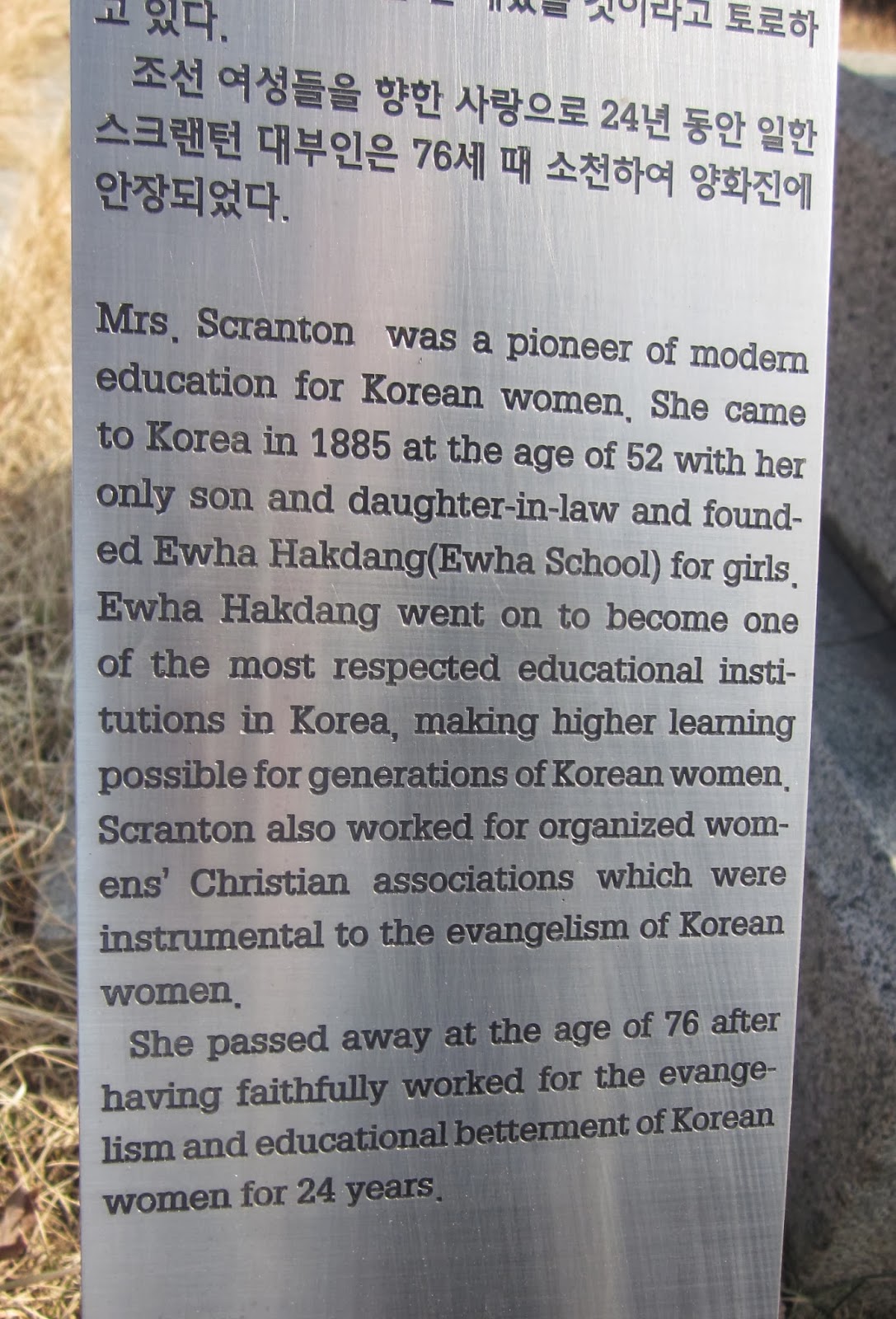
Mrs. M. F. Scranton, a pioneer of education for women in Korea, is described as a "forerunner of modern education for women." She came to Korea at the age of 52, from the USA, and passed on at the age of 76, having dedicated herself to spreading the Gospel and the betterment of Korean women for the last 24 years of her life.


Bookmark and Share

Friday, January 17, 2014

Players In Public Life


The "Yanghwajin Foreign Missionary Cemetary," on a hill in Seoul, Korea, was designated in 1890 as a site for burying foreign missionaries by Emperor Gwangmu, 26th King of the Joseon Dynasty, and the first Emperor of the Korean Empire. [Photo by Matthew Smith, used under the Creative Commons Attribution-Share Alike 3.0 Unported license.]

In the secularist view of development, Christianity is not always seen as a positive contributor to the cause.  That’s because it is often stereotyped as “institutional” rather than community-oriented, and relegated to “private inspiration” rather than viewed as a major player in public life.

The history of Korea, however, tells a different story. In the late 19th Century, Korea was mostly illiterate, without roads or railways, power or sewer systems. At this point in history, Protestant Christian missionaries (Presbyterians and Methodists) came from the USA, England, South Africa, Canada and other nations. 

These missionaries of the late 19th Century and the early 20th Century saw themselves as players in public life, and were embraced as such by many Koreans. Were these missionaries discipling a nation? I'd say so. Today, they occupy a place of honor in Korean history. 

I was privileged to visit the "Yanghwajin Foreign Missionary Cemetery," as it is called today by its caretaking church, while in South Korea this week. At this cemetery are 145 graves belonging to foreign missionaries and family members. The brochure for the cemetery says: “Abandoning promising careers back home, they came to share the light of the Gospel with ‘Corea’ which was then unknown. The missionaries profoundly influenced Korean society, not only by establishing hospitals and schools, but by affecting its intangible values, thus contributing to the abolition of the class hierarchy in old Korea.” About 231 graves of other foreigners are at the site as well, which is also called the Yanghwajin Foreigners' Cemetery.

The missionaries not only brought the Gospel of salvation, but helped lead Korea into modernization. They did this partly through the establishment of schools. At one point, the number of schools started by missionaries reached 400. It was from these schools that future leaders of Korea came. And this education was not only for males, but for females too, which changed Korea. 

Christianity “caught on” in Korea. They took to the Bible like kids in a candy store. I’m not sure of all the reasons for this, except to say it was a move of the Holy Spirit, beyond human orchestration or control. This was certainly the case with the Wonsan repentance movement of 1903, which led to the Great Pyeongyang Revival Movement, or “Korean Revival” of 1907, viewed by some as the major catalyst for the spiritual-social-cultural transformation of South Korea. 

I’ll say more next week.
Bookmark and Share

Friday, January 10, 2014

Culture-Shaping Vision


As today's post goes out, I'm in South Korea. I have spent the week teaching at the Asian Center for Theological Studies and Mission, focusing on the intersection between wholistic Christian education, theology of work, and human flourishing. Prayer would be appreciated, as tomorrow I meet with division heads of E-land, the largest fashion and retail company (by revenues) in Korea, sharing on the integration of wholistic Christian faith and work, then speaking on Sunday at the Suwon Central Baptist Church, and on Monday and Tuesday at a convention of the Korean division of the Association of Christian Schools International. They're working me hard over here, but I'm happy to speak as long as somebody will listen. (Apparently somebody wants to hear something, as this is my third speaking invitation to this country in the past six years.)

In last week's post, I asked why some parts of the world that have been "Christianized" and "churched," such as sub-Saharan Africa, have not experienced the kind of developmental outcomes that Puritan-spawned America experienced for 350 years. The history of South Korea is markedly different.  

When a ceasefire was called between North and South Korea in 1953 (technically, the war is not over, and North Korea seems bent on reminding the South of this now and then), both the North and the South were in shambles. They were among the poorest nations on the planet. Yet in 2013, South Korea ranked 9 among 187 countries in the 2013 Human Development Index published by the United Nations.

The chart below shows the UN rankings since 1980 among the 38 nations that make up the top 20% of the Development Index. [Norway is currently #1 and the US is #3.] What is particularly noteworthy, is the stellar rise of South Korea.

Some have wondered to what degree Christianity, directly or indirectly, has played a role in the development of South Korea. While cause-and-effect factors are often impossible to quantify [correlation is not the same as causation], the culture-shaping vision of Christian educators, civil servants, health workers, and business leaders in Korea is an important story to tell. It reads like a Dickens novel.

I'll say more next week.

The United Nations Human Development Index measures development by combining indicators of life expectancy, education attainment, and income. Each line in the above chart represents a specific nation. This chart shows the highest ranked 38 countries, which is the top 20% of tne 187 countries measured. The highlighted nation above is South Korea. (Click the image once to enlarge it.)


Bookmark and Share

Friday, January 3, 2014

Larger Than The Soul


The Puritan Gift was hailed by the Financial Times as one of the Top Ten Business Books of the Year in 2007. In this acclaimed book, British authors Kenneth and William Hopper (brothers) maintain that early American Puritans, such as John Winthrop, provided a foundation for the best of American business practice up until 1970. The results, until then, were positively staggering. 

But why did Christianity have such a positive affect on America's development, yet not in some other places of the world where Christianity has been introduced? As my friend Lowell Bakke once remarked, "Why are some cities that have been Christianized and churched, like Lagos, Nigeria, still full of poverty and corruption?"

Part of the answer lies in the terms Christianized and churched. In the case of America, Puritans saw no separation between "a man's shop and his chapel." They embraced a wholistic form of Christianity that saw fish farming and shoe making as God's work. 

In some parts of the world, "Christianization" has produced a withdrawal of Christians from business, arts and politics. A personalized and privatized Gospel has produced Christians with little or no interest in the way business is done, or how civil affairs are managed.

As Dr. Darrell Furgason observed: “In places like Africa...Western missionaries generally brought the Gospel in the way they learned it, as a purely soul-saving faith, with no real bearing on anything else—religion was a mostly personal matter, nothing to do with things like politics, science, law, economics….African people were given the Gospel, but not how to build a righteous nation, how to apply Christianity to everything."

As one African friend of mine put it: "Africans have understood the Gospel of Salvation, but not the Gospel of the Kingdom." Yes, the "Gospel of Salvation" points people to becoming born-again through faith in Christ's shed blood. Through this door we enter into a relationship with Jesus, and this is the beginning.

But the Gospel of the Kingdom helps us understand what salvation is for. We are not just saved from something, but for something. Personal salvation is a part of the Gospel of the Kingdom, but not the whole. The Kingdom is larger than the soul. 

One of the best descriptions I've heard on this topic is by Paul Stevens, in an interview I did with him several years ago at Regent College:


Or click http://www.youtube.com/watch?v=VitIItMXKc0.

Bookmark and Share

Friday, December 27, 2013

"The Eyes Of All People Are Truly Upon Us"

Few would contest that Christianity played a significant role in the development of early America, and the integration of Christian beliefs with everyday work was a hallmark of the Puritan mind. This mindset was summarized by Pastor George Swinnock, who said, "The pious tradesman will know that his shop as well as his chapel is holy ground." 

Such was the life of John Winthrop: Puritan, lawyer, businessman, and Governor of the Massachusetts Bay Colony for 12 years.

Winthrop is well known for an admonition he gave fellow colonizers in a sermon delivered aboard the flagship Arbella, in 1630. It was an admonition based upon the words of Jesus, who declared, "Let your light so shine before men, that they may see your good works, and glorify your Father, which is in heaven." Winthrop's exact words were: "For we must consider that we shall be as a city upon a hill. The eyes of all people are upon us."

Both John F. Kennedy and Ronald Reagan made reference to the "city on a hill" idea, in political speeches. Kennedy was more specific than Reagan, when he stated in 1961, "...I have been guided by the standard John Winthrop set before his shipmates on the flagship Arbella three hundred and thirty-one years ago, as they, too, faced the task of building a new government on a perilous frontier. 'We must always consider', he said, 'that we shall be as a city upon a hill—the eyes of all people are upon us.' Today the eyes of all people are truly upon us—and our governments, in every branch, at every level, national, state and local, must be as a city upon a hill — constructed and inhabited by men aware of their great trust and their great responsibilities."

Yet something important is missing from Kennedy's speech, and Reagan's, too. It's what Winthrop went on to say next: "So that if we shall deal falsely with our God in this work we have undertaken, and so cause him to withdraw his present help from us, we shall be a story and a by-word through the world. We shall open the mouths of enemies to speak evil of the ways of God, and all professors for God's sake."

We'll not hear this part of Winthrop's message in political speeches soon. But it describes our condition perfectly, as I see things. 

Bookmark and Share

Friday, December 20, 2013

The Greatest Christmas Gift

[This post first appeared December 25, 2009.]

One of my favorite carols is Joy To The World. The words are by Issac Watts, based on Psalm 98:

Make a joyful noise unto the Lord, all the earth; make a loud noise, and rejoice, and sing praise. Let the floods clap their hands; let the hills be joyful together before the Lord; for He cometh to judge the earth, with righteousness shall he judge the world, and the people with equity.

Some say Joy To The World is not about the birth of Christ in Bethlehem. They say it is about His second coming, not His first. (See http://en.wikipedia.org/wiki/Joy_to_the_World.)

The joy that is sung about, then, is a future joy that will occur when Christ returns, to “make the nations prove the glories of His righteousness,” in that full expression of His Kingdom-yet-to-come. But for me, the song makes as much sense as a celebration of the first coming of Christ.

While I’m looking forward to that full and perfect expression of Christ’s Kingdom-yet-to-come, I’m also celebrating the Kingdom-already-here. Jesus is Lord of all. Today! Not just in the future, but in this present moment also (Acts 2:36; 10:36).

Of course the Kingdom of God is not fully recognized yet, or perfectly functional right now. This will happen when Christ comes the second time. But the domain over which Christ is King (that is, His King-domain) includes both Heaven and Earth today.

This is the greatest Christmas gift: Christ the King has come “to make His blessings flow, far as the curse is found, far as the curse is found.” Right now.

Our Savior came to make His blessings to flow through carpenters, cops and CEOs who are reconciled to God, and reconciling all things to Him, including their work things! That's the idea behind Christ's coming in the first place. See II Cor. 5:17-20 and Col. 1:17-20.

So, no more let thorns infest the ground. By God's amazing grace, let's put our work gloves on, go to our workplaces after the Christmas holiday and pull up some bramble bushes--and plant some redwood trees.

Joy to the Earth! the Savior reigns; Let men their songs employ; While fields and floods, rocks, hills, and plains, Repeat the sounding joy, Repeat the sounding joy, Repeat, repeat the sounding joy!

Merry Christmas.

And now about ducks: Although I'm not a Duck Dynasty aficionado, one would have to be living under a rock to not be aware of this week's reaction to the father of the Robertson family, Phil, saying [in his own 'straight talk' way] that sodomy is a sin [along with fornication, adultery...and more]. It is rare to hear sin called sin these days, especially from pop icons. (It is becoming increasingly rare in the church.) For those who may not be aware, the Duck Dynasty television program has one of the largest audiences in the USA, with some 11 million weekly viewers, which is remarkable considering the family concludes each program with a prayer "in Jesus' name." Just in case you haven't heard, last night the family issued a statement: Robertson Family Response.

Here's Albert Mohler's comments on CNN about the matter, along with comments by Wilson Cruz, of GLADD: http://youtu.be/kqn3cwF5Zig


Bookmark and Share

Friday, December 13, 2013

Over 1.5 Million Hits

When we continue to hear about schools not allowing students to sing Christmas carols, it's refreshing to see one community that's not concerned about the P.C. police. Three cheers for the Yupiq Eskimos of Quinhagak, Alaska!

In this inspiring video, a project by the 5th grade class of the local state school, the wider community pitches in. The clip, created three years ago, now has over 1.5 million hits:


If the video does not play, click this link: http://youtu.be/LyviyF-N23A

Bookmark and Share

Friday, December 6, 2013

The Greatest Aims Of Our Faith

The most important command, Jesus said, is to "love the Lord your God with all your heart, with all your soul, and with all your mind." The next most important, He said, is to "love your neighbor as yourself" (Matthew 22:36-40).

Is your co-worker your "neighbor?" Even in Jesus' day, people were asking who their "neighbor" was. One thing's for sure, it's someone in close proximity! Today, we're usually closer to our co-workers than to our literal neighbors.

This doesn't minimize the importance of getting to know who lives across the street, but it's in the workplace where we have the most frequent and weighty opportunities to live out one of the greatest aims of our faith: to love our co-workers (and employees) as much as we love ourselves.

So what exactly does that look like at work?

We are patient with all our co-workers, and those we employ.

We genuinely care for their well-being, and express that care through action.

We affirm their abilities, and celebrate their success.

We don't try to impress them with our own success.

We are civil and polite.

We don't take advantage of them.

We are not irritable with them.

We forgive and forget their offenses.

We encourage their honesty, and discourage their dishonest ideas.

We help them lift heavy work loads.

We believe in them.

We hope for their best.

We stick with them through tough times.

We're there for them when they need us.


Does this all sound familiar? If you know your Bible it does. It was written by Paul the Apostle under the inspiration of the Holy Spirit, in First Corinthians 13. (I just tweaked it a bit to apply to the workplace.)

Onward and upward.

Bookmark and Share

Friday, November 29, 2013

My Personal Board Of Directors

This post first appeared on March 4, 2011. It is my most frequently visited post, exceeding all others by nearly 3 to 1:

I invite you to take out a clean piece of paper, and write the following at the top: My Personal Board Of Directors. (Yeah, I know it sounds like you’re back in school, but humor me. I think you’ll be glad you did this exercise.)

In the middle of the page, draw an oval to represent a large conference room table. Print your own name at one end of the table. Around this table, print the names of others who currently influence you the most, in a positive way. They may be living or deceased. They may be people you have not met, such as authors, media personalities, sports figures, or musicians. These are the voices you turn to, listen to, and learn the most from. These are the voices you take seriously when you want counsel, ideas, motivation, companionship, guidance, or a boost of confidence. Limit the number of Board Members to six or seven.

Now write a short description by each name that identifies the reason he or she is on your Personal Board of Directors. For example, “He always makes time for me,” or, “She never makes me feel like my ideas won't work.”

Finally, write a short personal note to one of your Personal Board Members (a living one), thanking this person and letting him/her know that he/she is on your Board, and why. Better yet, write a note to all of your living Board Members.

I was taught this wonderful exercise by my friend Dr. Kathy Koch (pronounced cook), Founder of Celebrate Kids, Inc. (http://www.celebratekids.com/). With her permission, I have shared it with many others.

Several of my Personal Board Members have sat at my table for more than 30 years. My wife has been on my Personal Board for over 40 years!

What a difference these people have made in my life! They are the vital friends I cannot afford to live without.

Who is on your Personal Board of Directors? Maybe you cannot limit it to six or seven. Get a bigger piece of paper. Thank at least two of them today, and be sure to let them know why they are on your Board. You will be glad you did, and they will be glad, too.

Oh...one more question: Did you include Jesus on your Personal Board?

He's been on mine for 55 years.

Thank you, Lord!

John Taylor (left) and Bill Laney (right) have been on my Personal Board of Directors for 30+ years.

Bookmark and Share

Friday, November 22, 2013

Why The Church Is So Silent

The following is by our friend Darrow Miller, co-founder of Disciple Nations Alliance, from his blog, Darrow Miller and Friends, reprinted by permission: 


Jihadists have a slogan: “First the Saturday People, then the Sunday People.” That is, "First we will kill the Jews, then we will kill the Christians."

Today, Christians are being persecuted from Nigeria through North Africa and the Middle East into Asia. Their places of worship are being destroyed, their girls and women are being raped, their homes and villages are being savaged and shattered. Christians are being targeted for mass killings as well as individual assassinations.

And all the time, the world seems to care very little. Influenced by cultural relativism, the West too often denies Islamist evil, pretends there is no clash of civilizations. “We must not critique another culture,” they say. Because of the West’s dependency on oil, governments are loathe to condemn Saudi Arabia’s promotion of their own militant form of Islam known as Wahhabism. The Saudis have spent $2-3B a year since 1975 to build mosques, Wahhabi schools (madrassas) for children, and Islamic institutes at major Western universities. All of this is funded by oil money. Money spent by the West to buy oil is seeding the West’s own destruction.

But it is not just the cultural relativists and Western governments that are silent. The church in the West is virtually silent about the persecution and decimation of our brothers and sisters in Christ in much of the 10/40 window. (See Kirsten Powers’ condemning article in The Daily Beast titled A Global Slaughter of Christians, but America’s Churches Stay Silent.)

The Jihadist vision is one of externally imposed law, legalism, and tyranny. They hate the Judeo-Christian worldview and the civilization of freedom it produced. I understand why Jihadists are opposed to Christians and Jews. What I do not understand is why the church is so silent. Why doesn’t the church in the West stand with her suffering brothers and sisters in Muslim countries? Indeed, we should side with Jews and moderate Moslems—our fellow sons and daughters of Abraham—who are being slaughtered by the Islamists. Even more, we should uphold and defend our fellow Christians. If we cannot stand with them in their hour of need, against what injustice will we ever stand?

Maybe Western Christians are silent because we are too comfortable.  Francis Schaeffer said that the two primary values of modern life are personal peace and affluence. Perhaps the church has been discipled by the culture. Perhaps personal peace and affluence have become the culture of the church. To challenge injustice and oppression might disrupt our comfort. Perhaps the church is silent because we want to be comfortable.

May God raise up a new generation of Christians whose god is not comfort.  May it be a generation concerned about injustice and oppression, a generation that will stand in word and deed with the suffering church.

In response to the question "What do we do?" see Darrow's follow-up post here.

Bookmark and Share

Friday, November 15, 2013

The Answer

For 30 years, starting in 1958, my Uncle Roy and Aunt Georgialee Mayfield lived with a group of 600-700 indigenous people in the Philippines, called the Agtas. They raised four children among this tribe, learned their language, put their words into written form and taught the Agtas how to read.

Why? Because the Agtas did not have the Bible in their own tongue, and the Mayfields wanted them to be able to read the Word of God, and know the Savior of which The Book spoke. In three decades, the Agta New Testament was complete.  

Roy estimates that by 1994, half the tribe had committed themselves to following Christ. “It was primarily through the Agta leadership and witness of individual believers that the Agta Church grew,” my Uncle tells me. “When the Agta New Testament was dedicated [in 1993], isolated Agta communities from a large geographical area were invited to participate for a two day affair. This experience motivated them to hold a gathering the following year. And for the past 20 years the annual Agta Christian Convention has been a venue where some find Christ for the first time, and others grow in their spiritual walk with the Lord.”

Roy and Georgialee are now retired. But not idle! Roy has been working on an English version of the New Testament, which sprang from his own desire for a "more readable translation." One that was "clear and flowing."

I can personally attest that Roy has succeeded in reaching this goal. I started reading Roy's translation about a year ago, and it is indeed "clear and flowing." I must tell you, it is my favorite version of the New Testament.

I am excited to let you know that Roy's translation of the Gospel of John, which he calls, The Answer, is now available in e-book form. I can't think of a more fitting Christmas gift than this remarkable translation of The Gospel of John, and I urge you to buy a copy for yourself and several as gifts for friends. You will not be disappointed. (At $2.99 per copy, you can buy quite a few!)

The Answer is Roy's initial publication of the Living Water New Testament, coming in due time. Roy says, "I am praying that The Answer will become an effective means of interesting more non-Christians in the hope we have in Jesus Christ."

Order here.


Roy and Georgialee Mayfield teaching Agtas to read their own language.


Roy (far left) and Georgialee with three of their four children and Agta friends.
Roy with an Agta friend testing his work. Roy was trained as a Wycliffe Bible Translator, doing graduate studies in linguistics at the Universities of North Dakota and Oklahoma, as well as Indiana University. He was trained to "translate in a way that does not read like a translation." As Roy puts it, "Any literary work calling itself a translation must be as understandable and idiomatic for the modern reader as the original was to the original readers of the content." After 30 years of applying this principle to the Agta New Testament, Roy has applied the same principle to his English translation of the Gospel of John, called, The Answer.
Roy and Georgialee are currently living in Carnation, Washington.
 Bookmark and Share

Friday, November 8, 2013

Questions That Plague

In 2007, American artist Jimmy Grashow began work on what might be his "final epic."  Inspired by the great baroque sculptor Bernini, whose fountains grace Rome, Grashow set out to create his own "fountain." A "fountain" so intricate, exquisite, and so large, it was not finished until 2010. Grashow's "fountain," however, was not made of marble. It was constructed from cardboard. 

Grashow's work wasn't really finished until 2012. That's because his plan from the start was to set his masterpiece out in the open, so rain would turn it to mush. On April 1, 2012, Grashow set it outside, and six weeks later, he laid the dilapidated mess to rest in a dumpster.

In The Cardboard Bernini, film maker Olympia Stone follows Grashow through his creation's life cycle, from conception to dumpster. We watch as Grashow painstakingly carves details on a huge cardboard fish: "It's very important that you do this right," he says, while carving out the back side of the scales, which nobody will see.

Viewers are confronted with questions that plague postmodern artists like Grashow: "What is the point of art, or the creation of anything beautiful that doesn't last?" And, ultimately, as Stone puts it, "What is the point of our lives in the face of our mortality."

As I watched this remarkable film, I marveled at our Creator's design of human beings as image-bearers of Himself, capable of extraordinary works of beauty, as Grashow and Bernini demonstrate. Through this film, I celebrated Grashow's humanity, as he celebrated it himself. I was blessed by his loving and devoted relationship with his wife, by his adult children, by his joy in living and his warm encounters with friends.

Yet, I was saddened. Saddened to see Grashow's fear of death, his sense of emptiness, and the absence of divine meaning in the work of his hands. I was saddened, once again, to realize how great a thief the postmodern "worldview of nothingness" really is, as seen in Grashow's faith that "everything dissolves in eternity."

This faith would have been inconceivable to Bernini, whose favorite book was Thomas á Kempis' Imitation of Christ. According to historian Paul Johnson, in Art: A New History, Bernini "believed that God had endowed him with unusual gifts and that, in return, he must make exemplary use of them to glorify his Maker and to make the world share his faith."


 Bookmark and Share

Friday, November 1, 2013

Starting A New Tradition

Our granddaughter, Aria, graces the cover of my wife's book, Fun Family Christmas Devotions: Advent Guide for Busy Parents

I know it's just November 1, but sometimes thinking ahead is smart, especially when it comes to starting a new tradition.

Christmas is not a new tradition, of course. But it has become so highly commercialized, that keeping the real meaning of it before the minds of children (and our own minds, too) is not always a piece of fruitcake! This is especially true when parents are busy, which seems to be the case for every family we know.

One way to address the challenge is to create a lead up to Christmas Day after your regular family Sunday dinner times during the four weeks prior. This is a way to build great Christmas memories, nurture faith in children's hearts, and keep the significance of Christmas at the forefront of the season.

Several years ago, my creative wife, Kathy (the only one I have, actually), wrote a delightful little guide to help make this a reality. This full-color, illustrated book is full of simple dramas, Christmas songs, crafts, games, and food ideas to help bring the wonder and joy of Christmas to life throughout the four weeks of Advent leading up to Christmas Day.

You may take a look at the content here.

This book comes with a CD of joy-filled Christmas music done mostly by family members. (Don't worry. It's far better than home movies.) If you'd like to get this book for 50% off, and free shipping within the USA, call toll-free 877-624-0230 within the US.

To get the discount, just say you're a reader of the Worldview Matters blog. [The discounted price is $10.]

Bookmark and Share